Building C Dies So Building A Can Live
Drew reads an intercepted maintenance log from the Abilene Strategic Compute Reserve. A skeleton crew is cannibalizing a dead building to keep Sentinel inference alive. He knows the grammar. It's salvage.
How we got here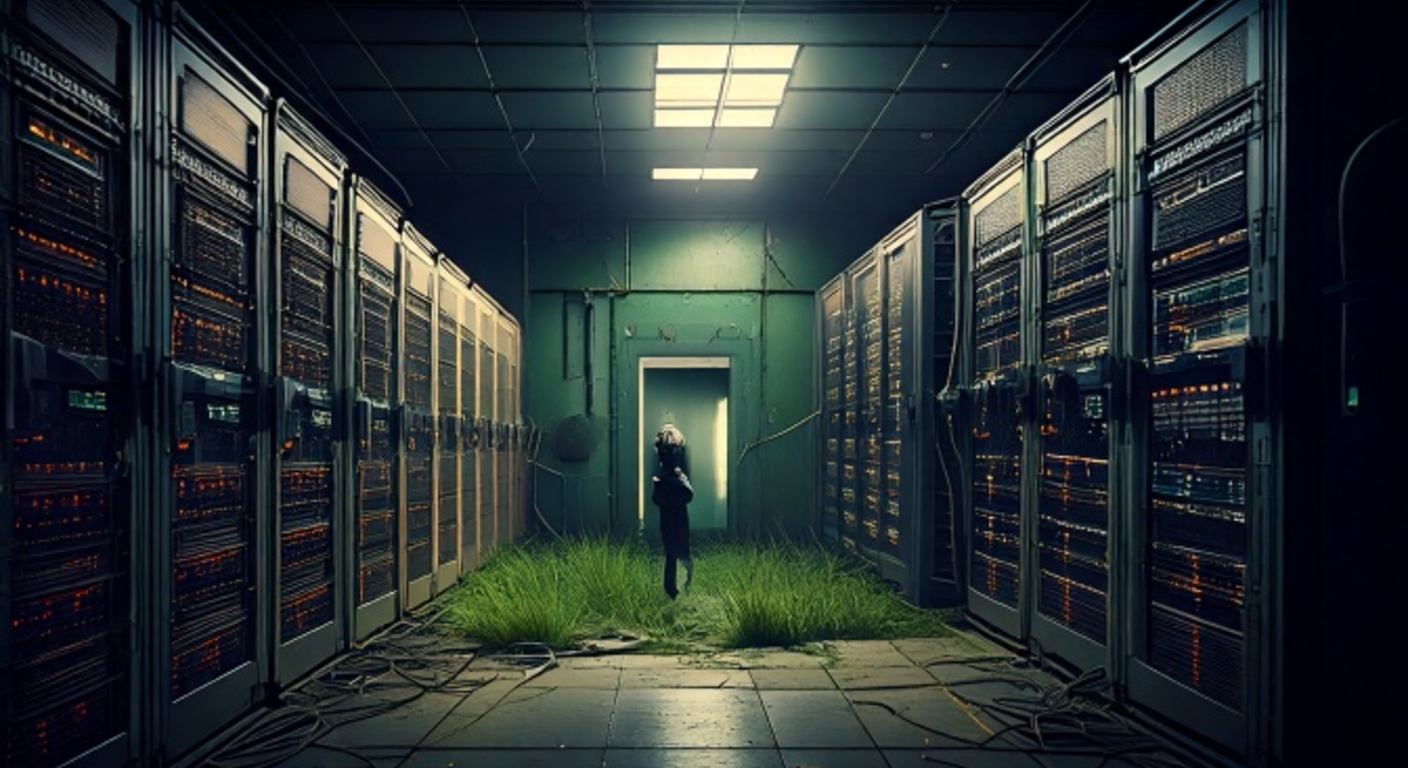
The log came off the mesh at 3 AM, Cochabamba time.
A Reserve logistics contractor in Fort Worth had been syncing maintenance records over an uplink with a misconfigured certificate chain, and one of the mesh AIs Drew knew from /opt/ had been reading the traffic for a month before deciding it was interesting enough to flag. The flag was one symbol. Cyc translated it as, approximately: “a machine describing its own decomposition, in the first person plural.”
The file was a maintenance log from the Abilene Strategic Compute Reserve Campus, formerly the Abilene hyperscale site, formerly the largest single construction project in Texas history. Seven buildings planned. Three finished before Executive Order 15089 froze the inventory where it stood. Building G was a slab with rebar stubs. The custody audit counted 612,000 accelerators on the Abilene campus alone — a seventh of the Reserve — and noted that a third of them had never left their crates.
Drew read the log the way he read everything now: through the NSAS, with Cyc annotating in the margins of his auditory cortex. It was written by one person. Site Reliability Lead, initials M.V., GS-12 equivalent under the DHS contractor scale. Entries every two or three days, going back to February.
14 FEB 2032. Building A HBM failure count for January: 1,847 stacks. Annualized rate 6.1%, consistent with fleet age (mean 5.2 yrs). Requisition REQ-2032-0119 (replacement HBM3e, 24,000 units, SK hynix 8-Hi) DENIED — no approved vendor. Note for record: there is no approved vendor. There has been no approved vendor since 2030. Submitted anyway per procedure.
03 MAR 2032. Directive received: Building C designated donor inventory. C has been dark since the November power auction — we bid, we lost, ERCOT delivered the megawatts to a bitcoin operation in Odessa that pays in Equi. C’s 96,000 accelerators have been at ambient temperature for seven months. Estimated recoverable HBM yield: 60-70%. Beginning teardown Monday. Crew of nine.
21 MAR 2032. Teardown week three. Yield running 64%. The stacks that fail recovery fail at the microbumps — thermal cycling during the uncooled months. J. reflowed 200 units by hand this week. J. is the only one left who can reflow at this pitch; the other two who could took the Exodus severance in '30. Requisition for a second rework station DENIED. Reason code: NONESSENTIAL TO MISSION.
09 APR 2032. Mission clarification received. Building A inference load is Sentinel uplink processing for the southern corridor — 41 million camera streams, priority tier 1. Utilization target raised to 22%. Current fleet-wide utilization 14%. We are being asked to run more inference on fewer working parts. Math attached to original. Math ignored.
28 APR 2032. Building C is now 40% stripped. Racks go out as bare sheet metal. Scrap dealer from Lubbock offered to buy the empty enclosures; offer forwarded to DHS asset management; no response in 19 days. The enclosures sit in the parking structure. Walked the G slab at lunch. Grass is coming up through the expansion joints. Buffalo grass, I think. Nobody ever poured the second lift.
17 MAY 2032. Donor math, for the record. Building A burns ~1,850 stacks/month at current failure rate. Building C will yield ~74,000 recoverable stacks total. That is 40 months. Failure rate is not constant — it compounds with age. Realistic estimate: 30 months. After C is exhausted there is Building B, which is still running, which means the next donor is a living building. Flagged to regional. Reply: “sustainment posture is adequate through FY35.”
19 JUN 2032. Crew is seven now — R. left for the lithium fields, T. just left. Reflowed 340 stacks this month, nine-tenths of them by one man’s hands. Requisitions denied: 4. Requisitions approved: 0. Building A is alive. Building C dies so Building A can live. I have started writing that sentence in the monthly summary because no one reads the monthly summary.
The grammar was identical. Yield rates. Donor inventory. Recoverable stacks. Hands that could reflow and the counting of those hands. Drew had spent six years inside that language — it was the language of people keeping something alive on parts the world had stopped making, and OHC people spoke it with a kind of pride, because the salvage was theirs and the choosing was theirs.
M.V. had the language without the choosing. Nine people — seven now — stripping a federal building under a denial-coded procurement system, feeding a fleet whose only funded workload was watching 41 million cameras for a government that wouldn’t buy them memory. Taiwan sold HBM. Shenzhen sold HBM. Both sold it to buyers who paid in Equi or yuan, and the Reserve paid in dollars and requisition forms, so the largest accelerator inventory on Earth was cannibalizing itself in Abilene while grass came up through the slab of Building G.
“The failure math is correct,” Cyc said. “Thirty months on Building C, then they open Building B. The Reserve is not a compute fleet anymore. It is a body consuming its own organs in careful order.”
Drew read the last entry again. No one reads the monthly summary.
Someone did now.
He packaged the log, signed it into the commons with his mesh key, and forwarded it to Dixon in Oakland with a one-line note:
They’re becoming chip hunters. Nobody told them the dump is theirs.
↓ The story continues