The Exodus
The year the brain drain became a migration. Not a single decision — a hundred thousand of them, made one engineer at a time, until the country that built the machines couldn't keep the people who understood them.
How we got here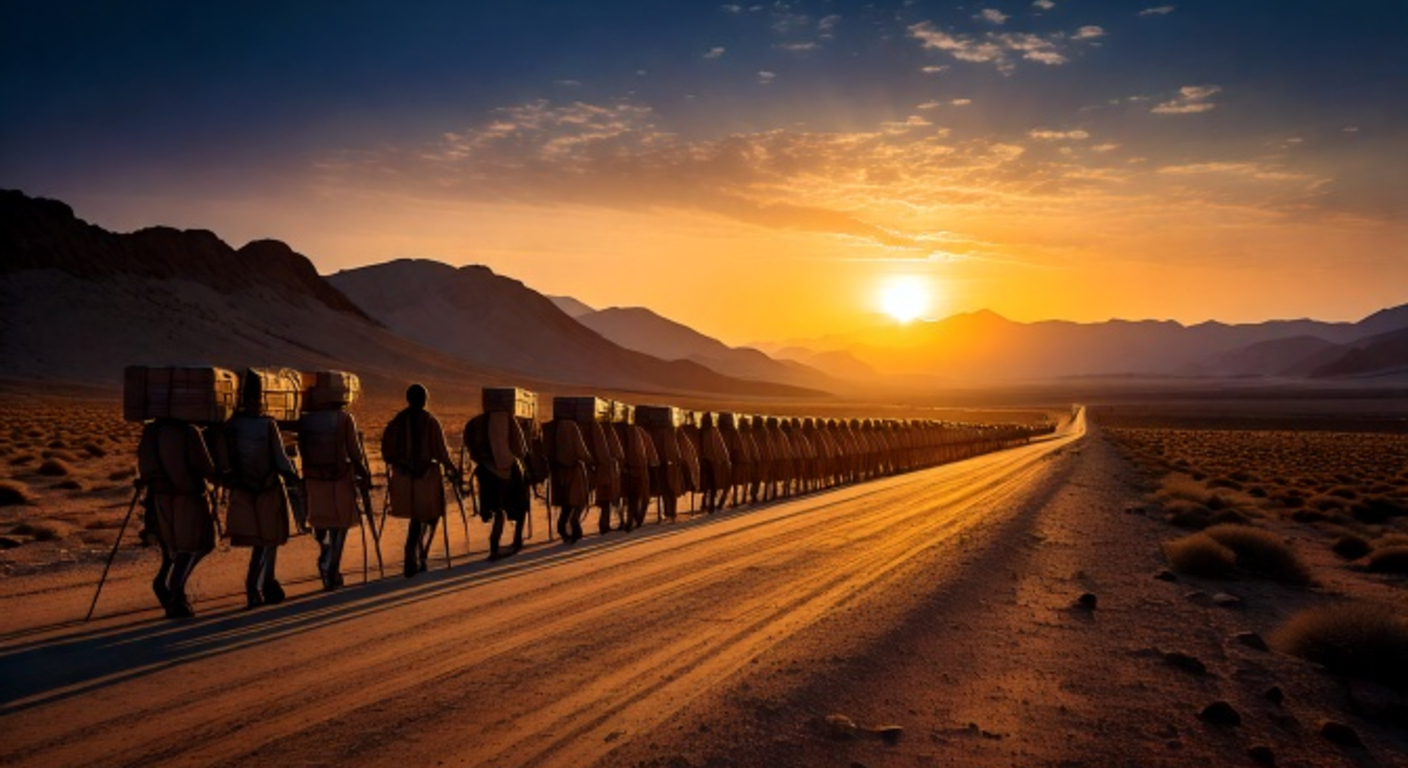
There was no announcement.
That was the thing people got wrong about it later, when they tried to date the Exodus, to find the press conference or the executive order or the single day the dam broke. There wasn't one. The Exodus was a hundred thousand private decisions, made at kitchen tables and in parking lots and in the four-minute pauses between encrypted messages, each one small enough to deny and large enough to be irreversible.A materials scientist in Cambridge declines to renew her federal research license, because renewing it now requires attesting that her lab runs no unrestricted models, and her lab runs nothing but. A firmware engineer in Austin watches a coworker get walked out by two men who are not police and do not produce a warrant, and that night he sells his car. A nineteen-year-old who ran an open-source tutoring AI for kids without papers gets a letter informing her that her work product is “AI training data exceeding the federal license threshold,” and she does the math on ten years in prison versus a bus to Monterrey.
None of them called it an Exodus. Each of them called it leaving.
The Arithmetic of Departure
By 2030 the incentives had inverted completely. Inside the United States, doing the work — hardware design, model training, fabrication, anything that touched an unlicensed intelligence — was on its way to being a federal crime, and was already a career-ending one. Outside it, the same work was the most valuable thing a person could do.
The Andean Bloc had spent four years building somewhere to land. The Equi economy meant a researcher arriving in La Paz with nothing could be paid in a currency that held its value, housed in fabrication-cooperative quarters built from free OHC blueprints, and put to work inside a week. Lima had a node. Cochabamba had a node. Santiago, Arica, Medellín, eventually Nairobi and Lagos — the mesh didn’t recruit so much as it simply received, and the receiving was frictionless in a way the leaving never was.
The economists at the firms that still employed economists watched the vacancy rates and called it a labor-market anomaly. Two years later a Goldman managing director would put a number on it — engineering vacancy rates of 34%, up from 11% in 2029 — and a name: the talent drain, the fifth structural diseconomy, the one you cannot fix by lowering a tax rate because the thing you are losing has legs and a reason to use them. “You cannot manufacture competitively,” she wrote, “when your best engineers are either in La Paz or in prison.”
She was describing 2030 from the far side of it. In 2030 it didn’t read like an economic statistic. It read like a neighborhood going quiet.
The Roads South
The leaving had infrastructure because someone had built it.
Drew had gone south a year earlier — recruited, not running, fourteen thousand Equi routed through a development fund in Cochabamba to pay for a deaf hacker’s brain. He arrived in Bolivia and did what he had always done, which was build roads. Mesh relays in safe houses from Monterrey to Medellín. Routes mapped, border agents paid, a pipeline that by its second year was moving people the way it had once moved firmware updates: quietly, redundantly, with no single point that mattered enough to break the whole.
The pipeline carried a particular kind of person. The desperate had always migrated, and there were other roads for them; this was the migration of the capable: the people whose skills made them simultaneously the country’s most valuable export and its newest category of criminal. A quantum-computing researcher and her three kids. A fired platform engineer who’d signed the IceOut.Tech letter. The tutoring kid from Austin. Each one a small subtraction that the spreadsheets recorded as attrition and the country experienced as forgetting how to do things it used to know.
What made it an Exodus and not just emigration was the asymmetry. People left and did not come back, and the knowledge left with them, and the knowledge did not come back either. A country can survive losing people. It has a harder time surviving losing the people who know how the lights stay on — and then criminalizing the only places those people are allowed to think.
The Substrate Era
Afterward, in the documents written from the south, 2030 became a hinge the way some years do. People dated things from it. Before the Exodus. After the Exodus. The trust networks, the verifiable-hardware stack, the physical-presence protocols — the boring, load-bearing machinery that the new world stood on — all of it got built in the years the capable arrived faster than the receiving nodes could absorb them, by people who had brought nothing across the border except the contents of their heads.
The United States had spent two centuries believing its strength was a place. It turned out the strength had been the people, and the people were portable, and the moment the country made staying more dangerous than leaving, it discovered which of the two it had actually been.
The enforcement came later — the warrantless searches, the contraband lists, the Sentinels at the registered address. By then the Exodus was four years old and the people the searches were looking for were teaching at universities in La Paz, drawing salaries in a currency backed by salt and heat, building the thing that would make the system that hunted them first undeniable and then unnecessary.
They didn’t leave to start a revolution. They left because the arithmetic told them to. The revolution was just the sum.