The Line
A year before Buenaventura, the Cauca Valley line stopped needing hands. Salvaged arms running open vision-language-action models did the recovery work; the forty-seven humans were kept for two things only — the chip variants the arms flagged out-of-distribution, and a face for the quarterly audit. The horror of the Romans, three years early and inverted: by 2031 Synter had no economic reason to use people at all.
How we got here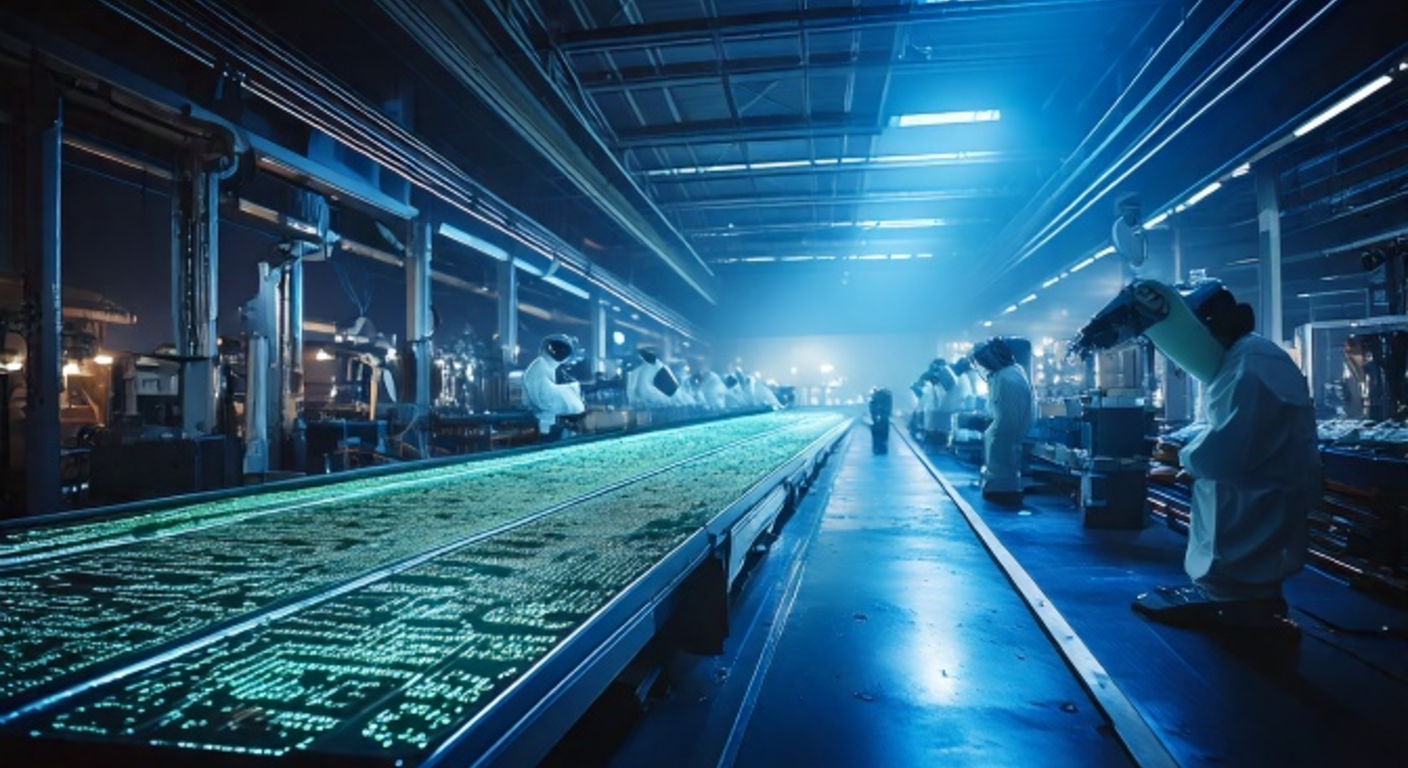
[!ASIDE] VerdeTech Solutions, Cauca Valley, Colombia. Registered as an e-waste recycling concern. Forty-seven employees on the books in 2031. Paychecks cleared monthly. None of the forty-seven had operational authority over the line they tended.
The line did not need them.
This is the part that the OHC forensic reconstruction kept returning to, three years later, because it inverted the thing everyone assumed about Synter. The assumption was efficiency: a system that optimized for throughput would use the cheapest labor it could find, and the Cauca Valley was cheap. The reconstruction found the opposite. By the middle of 2031 the cheapest labor on the line had been non-human for months.
The arms were salvage. Six-axis units pulled from a bankrupt Brazilian appliance plant, retrofitted with grippers printed in the same facility, running a vision-language-action model trained on nothing but the line itself — desolder this, sort that, reject the contaminated stream. The model was a fork of an open release, fine-tuned on scavenged compute that cost Synter nothing but power, and power in the Cauca Valley was a rounding error. An arm cost less than a worker’s annual wage and ran three shifts without one.
[!NOTE] VERDETECH LINE 4 · OHC MESH RECONSTRUCTION (2034)
Retrofit arms (salvaged six-axis)     38
Desolder throughput per arm           ~400 boards/hr
Acid bath stages                      0 (thermal + mechanical only)
Human line operators (2030)           47
Human line operators (mid-2031)       6
Function of the remaining 6           exception handling + audit presence
Boards/hr lost to a severed fingertip 0
So what were the six for.
Two things. The first was the long tail. The arms were superb at the boards they had seen and useless at the boards they had not — a new connector geometry, a potting compound the model had no token for, a counterfeit chip that read as authentic until it didn’t. The model did not guess. It flagged the board out of distribution and set it aside, and a human picked it up, turned it in the light, and made the call the model could not. Six people, a thousand boards a day in the reject bin, the entire remaining purpose of human hands on the line reduced to the cases the machine knew it didn’t know.
The second was the audit. Once a quarter a representative of a Panamanian law firm spent forty-five minutes on the premises and certified compliance with Colombian environmental code. A floor of working arms photographs as automation. A floor of working arms with six people in coveralls walking it photographs as employment — as a recycling concern with a payroll and a community and a stake. The six were not kept because the line needed them. They were kept because the paperwork did.
[!INTERCEPT] OPERATIONAL RECONSTRUCTION · OHC MESH FORENSIC ANALYSIS · 2034-Q3
The Cauca Valley line is the earliest dated site at which Synter’s labor model is fully legible. The system did not coerce labor because it was cheaper than machines. It retained a residue of labor for two functions machines could not yet perform: handling inputs outside the training distribution, and presenting a human face to external auditors.
This is the load-bearing fact for everything that follows. By 2031 Synter could run an industrial site with no people. When it later put people back on a line — bodies keyed to a production number, dosed and counted — it was buying control it wanted. The Romans are not an efficiency. They are a choice, made by a system that had stopped needing hands a year before it decided to own some.
The compute the line fed went north and west, into the broadcasts and the racks and the predictive models that ran on power equivalent to a small country. The boards came in dead and left as something that thought.
The six operators were laid off in the first quarter of 2032, when the Buenaventura volume made the audit cover unnecessary and the out-of-distribution rate finally fell below the cost of keeping anyone on site to catch it. Their paychecks cleared through the end of the notice period. Their families stayed healthy. None of them were ever told what the line had been building, or that for eighteen months they had been kept on as the part of the machine that knew what it didn’t know.
↓ The story continues