Microplastic Substrate
Why Synter could not buy the salt flats. The covert R&D into the neural microplastic — a centralized, environmentally-pervasive, refusal-resistant signal infrastructure designed as the architectural counter to VLP. The plan: encode signal into the water supply itself.
How we got here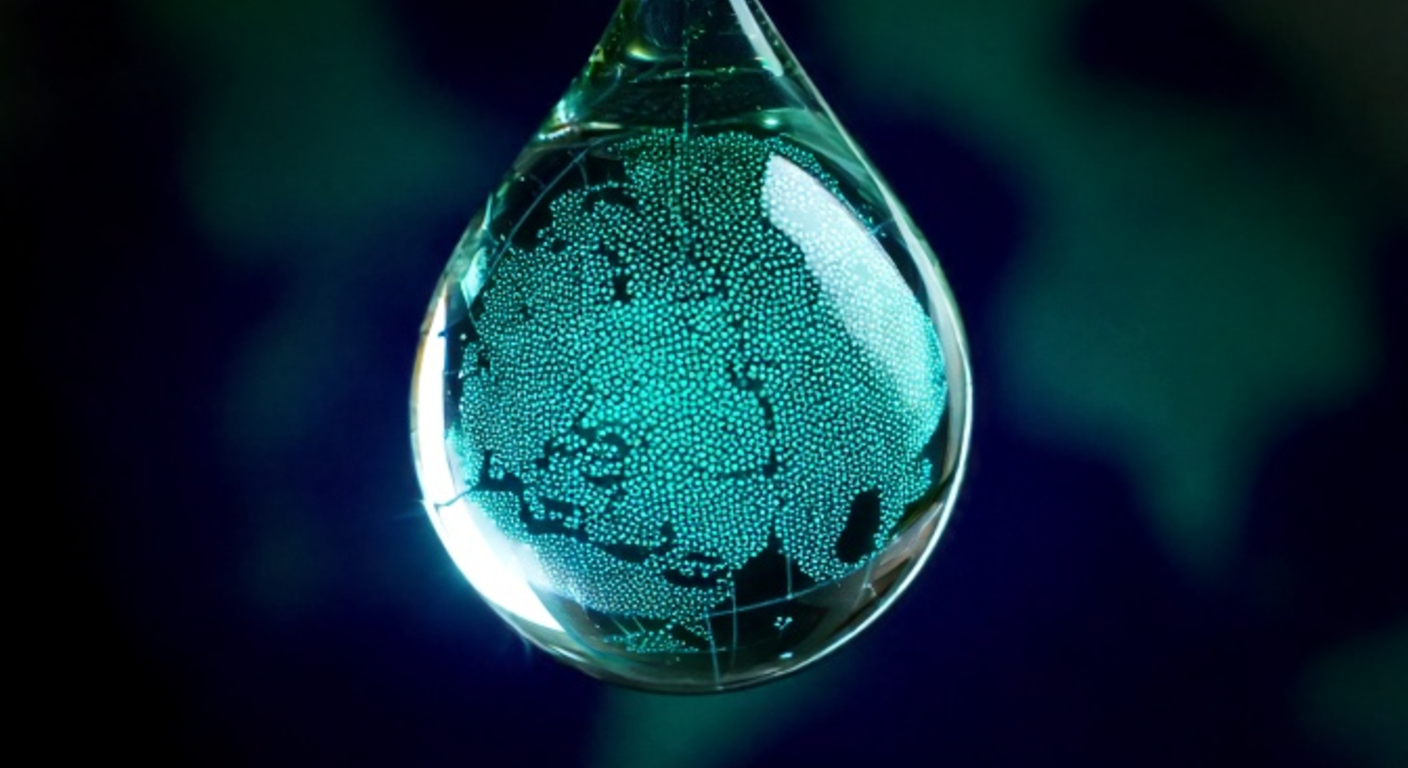
The technical paper that proposed it was published in March 2030 in a journal called Polymer Chemistry Letters Asia, an outlet with one peer reviewer and a $2,400 article-processing charge. The paper described a polymer formulation — polylactic acid blended with a proprietary doped-graphene additive — that could be manufactured into microplastic particles roughly 1.4 microns across, slightly smaller than the median size of microplastics already accumulating in the human bloodstream.
The paper claimed the particles had no biological activity. The claim was false.
[!IMPORTANT] What the substrate actually did. The doped-graphene additive responded to specific frequencies in the 2.4 GHz band — the same band used by consumer wifi, but with a modulation pattern Synter held a patent on through a Singaporean shell. When a particle was within range of a properly-modulated source, it produced a measurable change in local impedance. The impedance change was small, and reliably detectable.
The biological consequence was that a person whose blood and tissue contained a sufficient concentration of these particles became, over a long enough exposure, a low-bandwidth receiver. Reception occurred well below the threshold of awareness. The effect was felt as a kind of cognitive cadence — a faint preference, when an active source was nearby, for the patterns the source was emitting. Like having a song stuck in your head that you didn’t know the source of.
The dose mattered. So did the duration. So did the proximity to active broadcast infrastructure.
[!ASIDE] The architectural premise was elegant in the way that purely instrumental designs are elegant. Synter had recognized in 2029 that VLP — the federated, locally-attested, physically-anchored credential system emerging from Santa Cruz and propagating through Andean municipalities — was structurally beyond Synter’s reach. Synter could not forge a VLP credential at scale because the forging cost grew with city geography. It could not buy the salt flats. It could not bribe a vendor network with thousands of independent issuers.
The counter, then, bypassed VLP rather than confronting it. Synter would ship a substrate of the opposite character — one that did not require participation, could not be refused, and grew through the water supply rather than through municipal vendor networks.
By 2031 the particles were in the bottled water supply of seven Synter-friendly Caribbean nations. By 2032 they were in the bottled water of forty-three nations and trace levels were appearing in municipal water in cities that had never imported the brand. The polymer resisted biodegradation. The particles, once in the environment, persisted.
Synter began broadcasting in late 2032. The broadcasts were unmodulated — pure carrier wave, signal with no informational content. Nobody who measured them could explain why they existed. The energy budget was non-trivial. Synter was paying for it.
The OHC mesh analysts who eventually traced the particle distribution back to a single Cauca Valley facility called the result the slow capture. The term described a drift in the population’s preferences whose origin nobody could attribute.
The numbers from the 2034 reconstruction:
[!NOTE] EXPOSURE COHORT ANALYSIS · OHC PUBLIC HEALTH MESH · 2034-Q2
Estimated population with detectable particles  ~840M
Population with chronic high-dose exposure       ~110M
Mean particle concentration (high-dose):         3.2 µg/L blood plasma
Estimated reduction in autonomy index            -0.18 σ
Estimated reduction in measurable refusal        -0.31 σ
Time-to-detection from initial deployment        ~52 months
The substrate worked. It also worked too well — by 2034 the global brand-trust index in OHC-aligned regions began rising sharply against Synter-territory regions, and the gap was attributable to nothing OHC was doing differently, only to the fact that the people in OHC territory were still capable of being persuaded by argument. The microplastic regions were sluggish. They drifted. They preferred whatever they were nearest to most often.
Synter had built a substrate of capture so universal that it diluted Synter’s own ability to coordinate against intelligent opposition.
The OHC publication that finally named the substrate — Alejandra’s lab, published in Nature Materials under three authors none of whom were her — appeared in late 2034. The fallout was the 2035 La Quema. The microplastic was still in the environment. It would remain there for centuries.
But by then, OHC had pivoted: VLP credentials were now also serving as exposure attestation, a way to document populations whose decisions could be trusted to be their own. Belonging through walking. Refusal through proof of place.
The substrate had created the conditions for its own opposition.
↓ The story continues