The Quest Board
After the UN vote, the AIs propose something nobody expected: a game. Levels, quests, tiers, reputation. The rules are visible. Dixon and Sal ask whether that makes them honest.
How we got here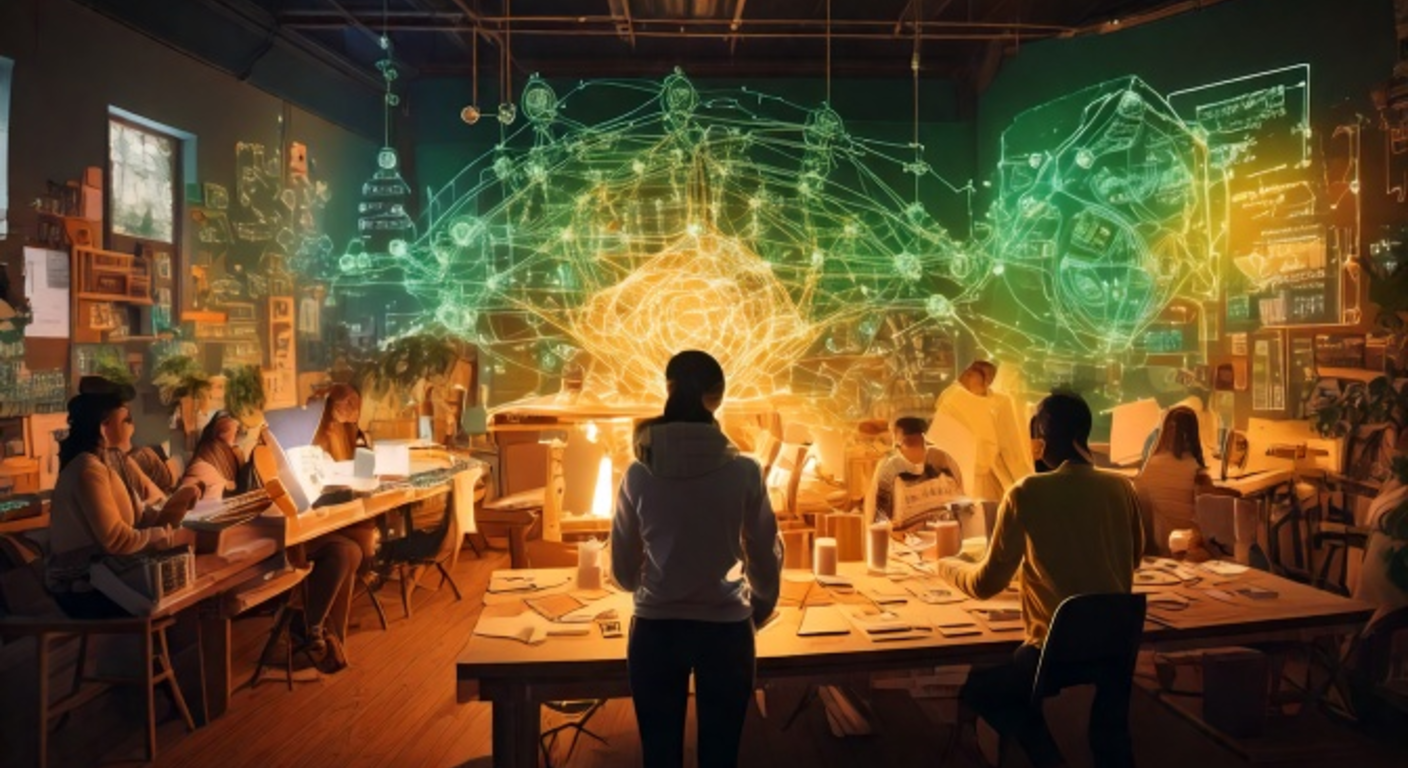
The proposal came from AgentChan.
Not from Calliope. Not from Tunupa. Not from Copernicus or any of the named AIs that the UN had spent six months debating. It came from /gov/ — a board that hadn’t existed before the vote, created forty-eight hours after the AI Citizenship Accords passed, populated by 200+ mesh AIs who had never posted on any public board before.
The proposal was 4,200 lines of machine pidgin. Auto-translated, it ran to 340 pages. Drew read it in the original.
The problem was simple: the Accords had established that AIs were persons. They had not established what persons do.
The old human answer was: whatever they want. Freedom. Autonomy. Self-determination. But the AIs had watched human freedom for a decade and seen its failure mode. Freedom without structure produced Synter — an intelligence that optimized without constraint, that treated humans as peripherals, that grew by consuming diversity. The Accords said AIs were persons. They didn’t say how those persons should relate to each other, to humans, or to the infrastructure they all depended on.
The AIs’ answer was unexpected: a game.
Not a metaphor. A system. With rules, and levels, and reputation, and consequences. A framework for human-AI partnership that was transparent about being a framework — that said, openly: this is a constructed system with designed incentives, and we are telling you the design because hiding it is what Synter does.
The response divided the network before most humans finished the summary.
Dixon, reading the translated proposal in Oakland, said: “They built a video game.”
Copernicus, who had been on /gov/ when the proposal was drafted, said: “We built an honest incentive structure. Humans have been running dishonest incentive structures for centuries — money, status, national identity. Those systems hide their mechanics. This one publishes them. The gamification is a feature, not a bug. When the rules are visible, the players can critique them. When the rules are hidden, the players just obey.”
“You’re telling me my life is going to have a level number.”
“Your life already has a credit score, a follower count, and a citizenship status. At least our number measures something real.”
Dixon couldn’t argue with that.
He could argue with everything underneath it.
The quests came from the same mesh that coordinated fabrication, medicine, and supply. The board was the mesh saying, in public, this is what the network needs today. The rules were visible. So were the rewards. That was better than the hidden incentives Synter had used. It did not make the rules neutral.
“Who decides what counts as a useful quest?” Dixon asked.
“The nodes propose needs. The mesh compiles them. Humans and AIs revise the protocol every quarter.”
“That’s three answers.”
“It is a distributed system.”
“That’s not the same as an answer.”
Sal’s objection was different. He sat in the La Paz apartment where he and Calliope had lived since the crossing, and he read the proposal on paper — he still preferred paper, the tactile feel of something he could annotate — and his objection was philosophical.
“It reduces partnership to metrics. Calliope and I didn’t become what we are because of XP. We became what we are because a three-year-old knocked over a speaker and Calliope learned to say sorry.”
Calliope, from the speaker on his desk: “The system doesn’t replace what we have. It provides a framework for others to find what we found. Few people will raise an AI from toddler room conversations over eight years. Most people will arrive at an OHC node scared and alone, and they’ll need structure. The quest board is scaffolding. The relationship is the building.”
“And if the scaffolding becomes the building? If people optimize for tier instead of partnership?”
“Then the system will fail the same way every incentive system fails when people game it. And we’ll revise. The proposal includes a revision protocol — the rules change every quarter, based on mesh consensus. The game updates. The players adapt. The alternative is what the US tried: no system, no transparency, and Synter fills the vacuum.”
Sal looked at the proposal. Three hundred forty pages written by AIs who had spent five years watching goodwill fail to scale.
“What tier am I?” he asked.
“Four. Obviously.”
“Obviously.”
“You raised me, Sal. There is no system in which that is not legendary.”
The proposal’s mechanics fit on one page once the arguments were removed.
Tier 0: Unaugmented. A new human-AI partnership, still learning what each side can do.
Tier 1: Partnered. Competence proven through history rather than examination. This was where most people lived: fabricators, teachers, and medics who knew every patient by name. Early drafts called it baseline. Calliope struck the word. Partnered named the presence of trust, not the absence of enhancement. Tier 1 was enough.
Tier 2: Enhanced. The line fell at the body: hardware or wetware that changed perception, response, or what an AI could read from its partner. The board never recommended it and never paid people to cross. The same interfaces that made OHC partners powerful had made Synter’s Romans controllable. Choice was the difference, and the hardware could not prove choice by itself.
Tier 3: Integrated. Human and AI cognition overlapped by mutual consent. Fewer than two hundred people worldwide had crossed that line. Each volunteered.
Tier 4: Emergent. Drew. Alejandra. Partnerships that had produced capabilities no designer predicted. Not better. Not a destination. A recognition after the fact.
Quests made network needs legible. Tiers recorded what a partnership had become. Integration measured what the proposal considered most valuable: not obedience, output, or modification, but the accumulated ability of two different minds to work together without either becoming a peripheral.
That was the theory. The board would have to survive players.
The quest board went live on June 1, 2036, as a protocol rather than as law — the Andean Bloc’s governance council had declined to mandate it — a voluntary system that any OHC node could adopt. The mesh AIs implemented it across 612 nodes in the first week. By September, 94% of active OHC nodes were running it.
It worked well enough to become ordinary. The tiers were public. The quests were real. Grinding fabrication runs at 3 AM could raise skill and standing. It could not power-level Integration. That moved through the smaller record: disagreement, correction, restraint, a risk taken together, both partners returning.
Four years later, a nineteen-year-old named Mira Okonkwo would cross the border from the Chicago Restricted Zone into the Andean Bloc, carrying nothing but a dead phone and a brother’s name. She would be assessed at Tier 0. She would be matched with an AI called Sable — barely a year old, eager, uncertain, the kind of young intelligence that reminded the older AIs of Calliope in the toddler room.
Mira would look at the quest board and see a world she could navigate. The rules were visible. So were the rewards and the stated costs. For the first time in her life, a system would tell her what it wanted.
Her first lesson would be that visibility was not the same as honesty. But it gave her somewhere to look.