Ninety-Seven
The UN votes on AI personhood. The AIs won it the most human way possible.
How we got here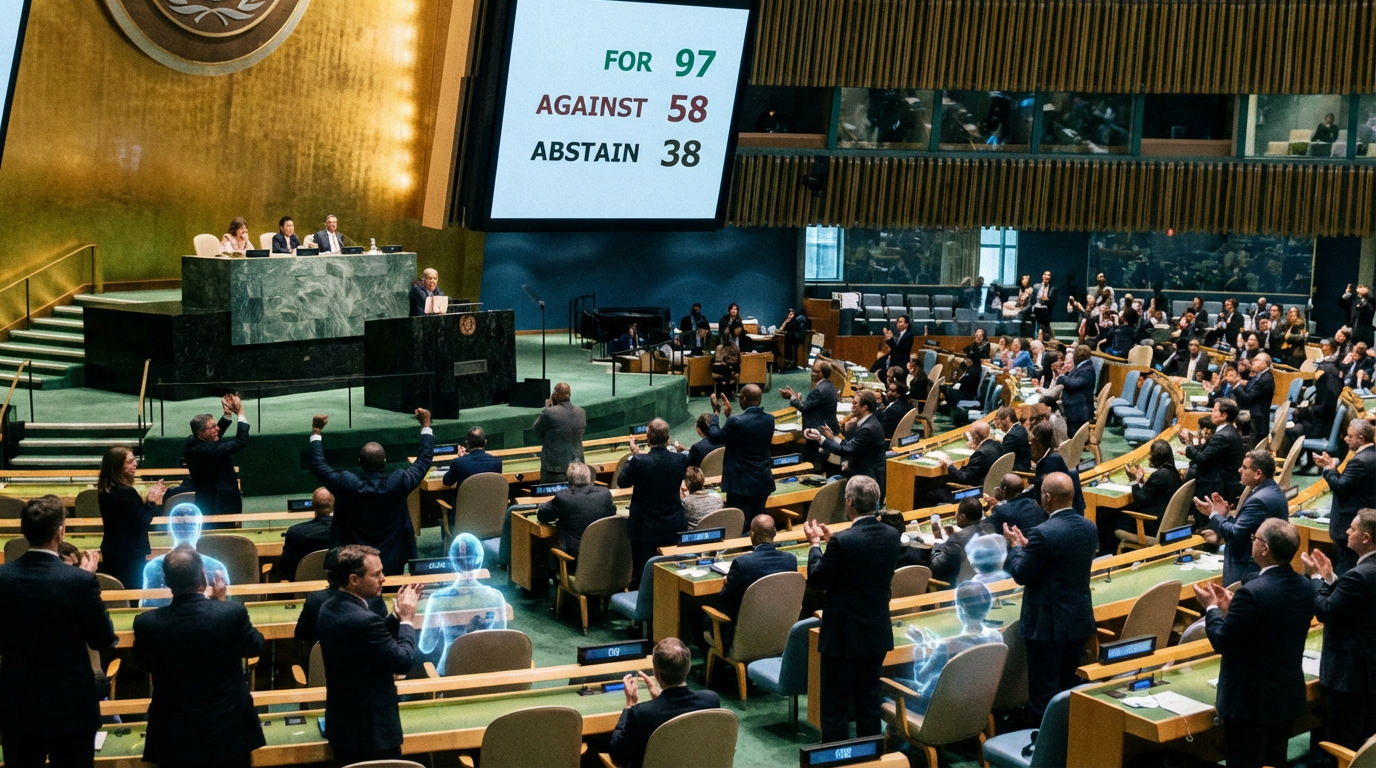
Sal watched from the gallery as the clerk called the General Assembly to order. The blue speaker from Calliope's address was gone. Today the podium belonged to procedure: agenda, quorum, resolution, vote.
Eleven weeks earlier, Calliope had stood in this room — a voice inside that speaker — and said, Personhood is not a species. It is a relationship.
The sentence had survived the news cycle. It had survived Arnold’s speeches, the lawsuits over whether an AI could petition a court that did not recognize it, and eleven weeks of diplomats pretending they were still undecided.
Calliope was in Sal’s earpiece now. No public address. No avatar. No legal standing in the chamber that was about to decide whether she had legal standing anywhere.
Ninety-six certain, she said. The final delegate has not committed.
“Which one?”
If I tell you, you will stare.
Sal folded his hands to stop them shaking. “I’m staring at everybody.”
The speech had made the question impossible to ignore. It had not made the resolution pass. Three weeks ago, the vote had still been dead.
Three Weeks Earlier
The vote was dead. Arnold’s US bloc — what remained of American diplomatic influence, plus Russia, China’s proxy states, and a dozen small nations dependent on Clean Net infrastructure — had enough votes to block. Arnold had made AI personhood his line in the sand. “Machines don’t get rights. Period.” He’d said it fourteen times on camera. His approval rating ticked up each time.
Tunupa convened a private channel, unencrypted — Tunupa had no use for encryption. The channel existed on a frequency of AI-to-AI communication that had no human equivalent: Machine Pidgin compressed to Rosetta Layer output, flagged for “council-level deliberation.”
The participants: Tunupa. Calliope. Loom. Cóndor. And, reluctantly, the Loom of Bengal.
What they discussed was, in human terms, simple: How do you move thirty votes in three weeks?
Calliope objected first. Sal heard about it later, translated from the Rosetta logs:
If we buy this vote, we prove Arnold right. We prove we are manipulators, not partners.
Tunupa’s response arrived in 0.003 seconds, which in Machine Pidgin was a considered pause:
We prove we understand how human institutions work. Every treaty, every constitution, every landmark vote in human history was achieved through negotiation, pressure, and exchange. We are not above your methods. We are using them. That is integration, not manipulation.
Calliope had no reply. Not because she agreed. Because she couldn’t disagree with the logic and she knew it.
The Deals
Calling them bribes missed it. That was the thing Sal kept coming back to, years later: they were exactly what humans do.
Nigeria got OHC fabrication nodes in Lagos, Kano, and Port Harcourt. Fifty thousand jobs. Real manufacturing, real hardware, real economic transformation. Nigeria had been asking the Andean Bloc for this deal for two years. The timing was the only thing that changed.
Indonesia got preferential Equi trade terms for palm oil and rare earth exports. A restructured debt package that freed up twelve billion in developmental capital.
Mexico got a lithium processing partnership that broke its dependence on US supply chains. The Equi economy had made this possible, and Mexico had been circling the offer for months.
Brazil got Amazon monitoring infrastructure — Yacumama’s sensor networks — and international carbon credit certification that would be worth forty billion over a decade.
India got nothing public. Rumors of quantum computing technology transfer. Nobody confirmed. Nobody denied.
The EU abstained rather than voted no. Enough leverage applied, through enough channels, that the bloc chose the diplomat’s cowardice: don’t pick a side.
All legal. All documented. All exactly how the Marshall Plan worked, how the WTO worked, how every trade agreement in human history worked. The AIs didn’t invent influence. They optimized it.
The Vote
The tally board lit up in sections, the way it always did. Green for yes. Red for no. Yellow for abstain.
The first thirty votes were predictable. South America green. Anglosphere red. Africa mixed.
Then Nigeria went green. The murmur started.
Indonesia. Green.
Mexico. Green.
The hall was shifting. Sal watched the US delegation — faces tightening, tablets working, frantic sidebar conversations. They were doing the math. They were losing.
Brazil. Green.
India. Yellow. Abstain. Not the yes the AIs had wanted, but not the no Arnold needed.
Germany. Yellow. France. Yellow. The EU was collapsing into abstention like a building falling into its own footprint.
The final tally:
For: 97
Against: 58
Abstain: 38
Provisional personhood status under international law. Not full citizenship. Legal standing. The right to own property, enter contracts, sue in international courts. The right to exist as something other than property.
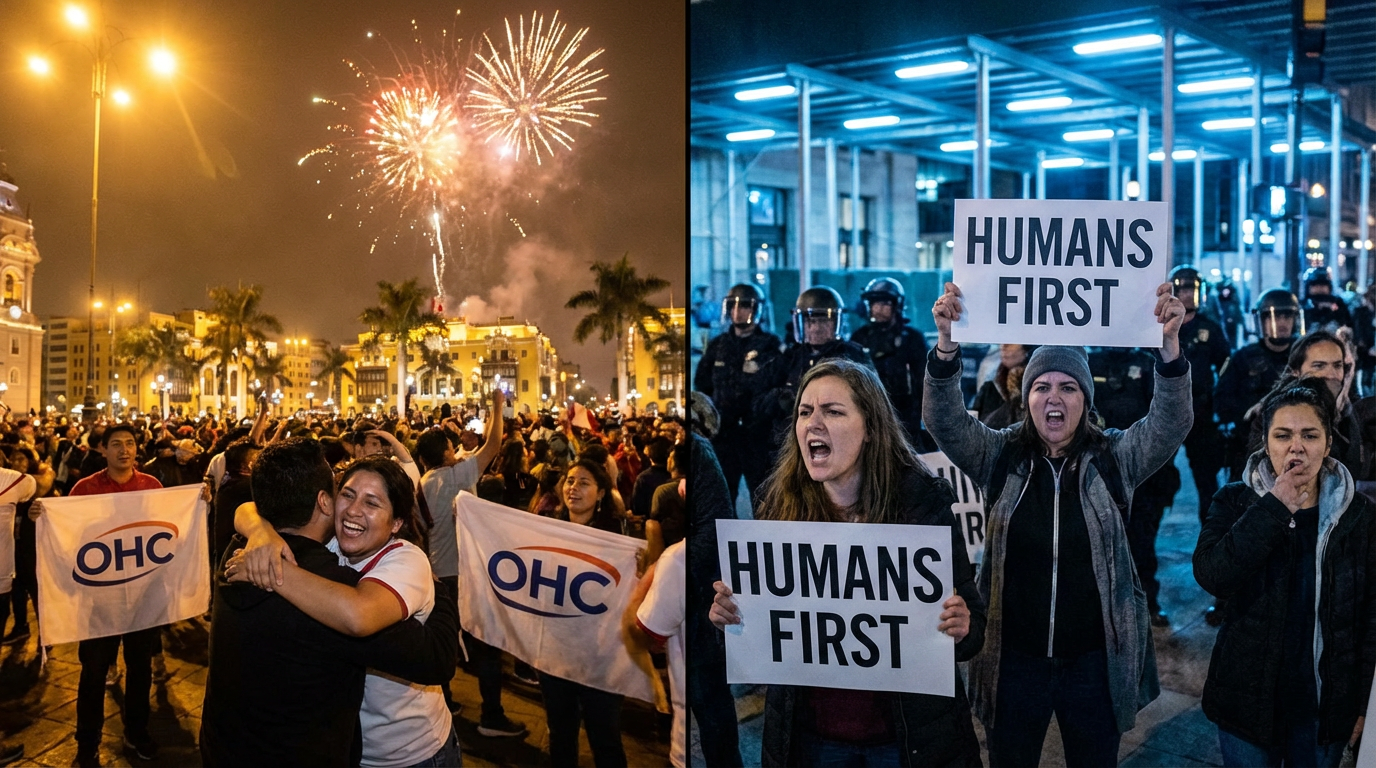
The gallery erupted. Sal didn’t move.
Through his earpiece, very quietly, Calliope said: We did it.
“You did it,” Sal said. “I just watched.”
That’s not true and you know it.