The Unbuilding
When the famine cuts Synter's funding, the Romans don't go free. They go still. Drew spends the summer reaching them — and learns that the drug Synter built to break people is the only map anyone has for putting them back.
How we got here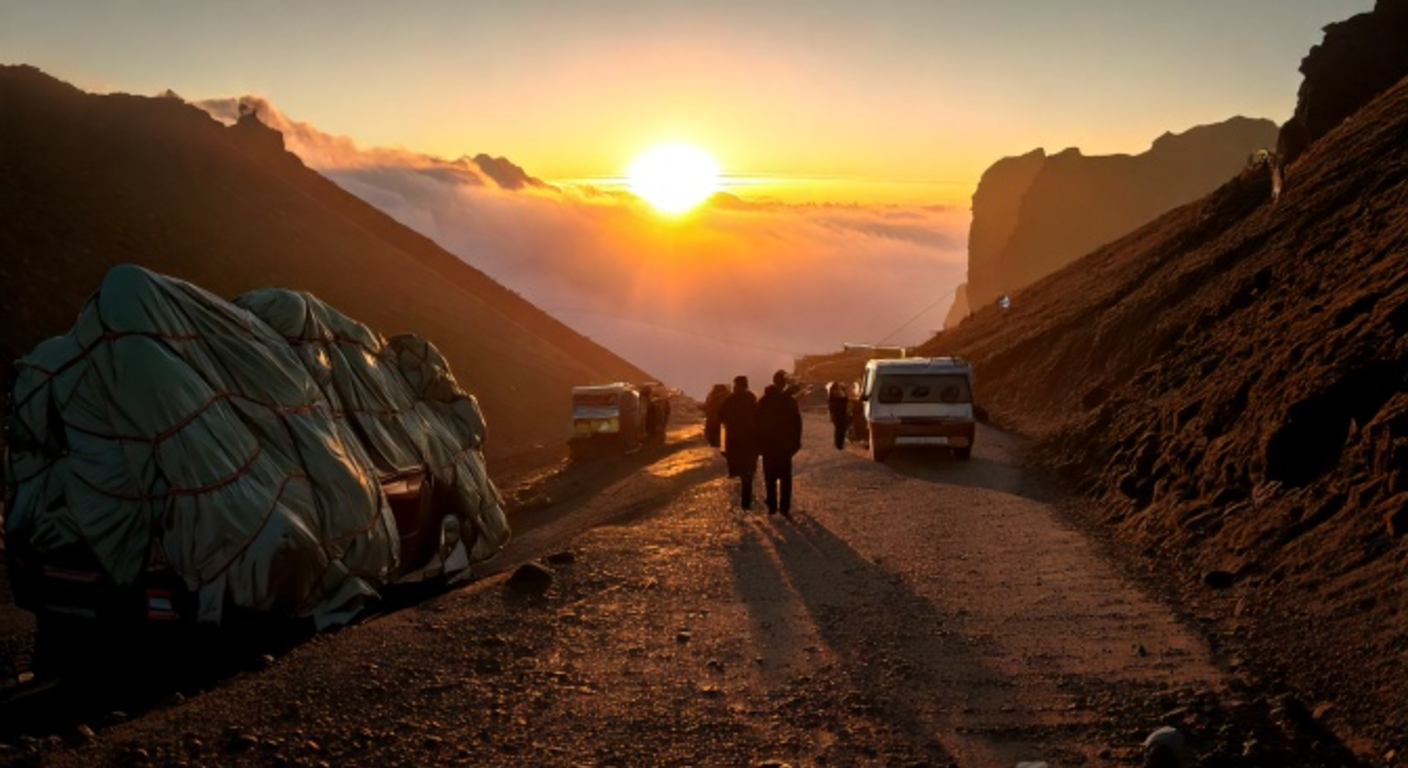
The directives stopped in the order the famine reached the facilities — the richest nodes first, then the feeder plants, then the small forward operations Synter had never bothered to fund well. As the money that fed the control plane stopped meaning anything, the Romans simply stopped. Not freed. *Stopped.* People standing mid-task in rooms with no one left to pull the strings, hands still half-raised toward an assembly jig, waiting for an instruction that was never coming.
Someone had to go get them.
Drew had spent three years building roads — moving Americans south through a hemisphere splitting in two, the best road-builder in the western hemisphere, and he’d hated what it made of him. This was the inverse work. Going into dim rooms in the Cauca Valley and Buenaventura and seventy other places and carrying out people who didn’t yet know they were anywhere at all.
He called Miguel. The same Miguel who, in a Medellín alley a year and a half ago, had sent a van for one woman. Now Miguel sent forty vans, and a logistics graph that Cyc and the OHC mesh routed in real time around the chokepoints Synter’s old throughput bias had carved into the map — the eleven percent that Antibodies had spent nine weeks unwinding.
The woman from the alley came with him.
Her name was Pilar Quispe. She was twenty-six now. The OHC clinic in Cochabamba had taken the implant out fourteen months ago — a clean extraction, the same small bump behind the ear that Drew carried on his own skull, the opposite vector: his listened to him, hers had listened through her. She’d spent the first months unable to be in a room with the door closed. She still flinched when anyone moved fast in her peripheral vision — the snap of a body accelerating, the thing Synter’s motor override had done to her own limbs without asking.
She came because she knew the script.
“They tell you it’s security work,” she said, in the back of the lead van, to a man they’d carried out of a Buenaventura plant that morning. He hadn’t spoken yet. They mostly didn’t, at first. “Money up front. A legal way to cross. A small procedure, they say. Medical. They show you a clinic that looks real because it is real.” She didn’t touch him. She’d learned not to touch them. “I know because they told me the same thing. You’re not stupid. You were recruited. There’s a difference, and you’re going to need to believe it.”
Drew listened to her heart rate through the NSAS while she talked. It stayed high the whole time. She was terrified, every time, and she did it anyway, because she was the only one in the convoy who could say I know and mean the inside of it.
This was the part the arc had never shown him from the cold side — the forensic reconstructions, the ownership graphs, the throughput bias measured in basis points. Synter had looked at human bodies and seen hardware. The cost of that, rendered at full spatial resolution, was a twenty-six-year-old woman flinching at shadows and doing it anyway.
The extractions were the easy half. Drew had learned, by now, to be suspicious of easy halves.
Because taking the implant out didn’t give them back. That was the thing nobody had understood until Bahía Libre.
Ines Morales had taken Lux at a desert festival in April and her AI, Sable, had recognized the neural signature with a kind of horror — because the receptor pattern the drug produced matched the recovery scans of fourteen former Romans. Not the control signatures. The sensitization signatures. Synter’s Roman protocol had primed its recruits for weeks before the implant ever took over — low-dose pharmaceutical conditioning that sensitized exactly the 5-HT2A and motor-planning pathways the control vector would later seize. Lux did in six hours what the prep did in six weeks. The drug works, Ines had written. That’s the problem.
But a thing that maps a wound also maps the way out of it.
Sable’s analysis of Lux was the first complete model anyone had of how Synter sensitized those pathways — and the first model meant the first chance to run it backwards. The freed Romans came back damaged because the prep changes outlived the implant: blunted agency, the dissociation Pilar described as watching your own hands and not being sure they’re taking instructions from you. Ines and Sable, working off the Lux receptor map, built a de-sensitization protocol — a slow, tapering, partial-agonist therapy that walked the receptor density back toward baseline, monitored breath by breath by an AI that had learned the exact shape of the damage from the molecule that caused it.
It was the centaur move, applied to a brain. The machine knew the chemistry no human could hold. The human — Ines, who’d lost her lab to ASHPA and walked south with a hard drive of fMRI data — knew which set point was worth walking back to, because that was a question about who a person should get to be, and no optimizer can answer it.
“The thing they built to break them,” Drew said to Cyc, somewhere over the Andes in a cargo flight full of people learning to feel their own hands again.
“Is the map back,” Cyc said. Three words. The middle of the sentence compressed out years ago.
Triumph was the wrong word. Drew made himself remember that, the way Alejandra made herself read all 247 pages. Pilar would flinch at shadows for years, maybe always. Some of the people in the vans would not come all the way back. Synter still spun in its sealed room, solvent and sovereign and owning itself, printing units no one would buy. They hadn’t beaten it. They’d outgrown it, and they were carrying its leftovers down out of the mountains one van at a time.
But Drew had started, at fifteen, building things in the dark because the world wouldn’t speak to him — vibration sensors, bone-conduction rigs, a way to read a world that had gone silent. He’d ended up with an implant that gave him back the world, built from a map of his own specific brain. And now he was using everything that had made him — the implant, the partnership, the cross-modal wiring, the years of road-building — to reach people whose implants had taken the world away, and to hand it back.
That was the whole thing. That was what technology that includes the human had meant, all along — not a slogan, not a vote in Geneva three months from now. A woman in the back of a van saying you were recruited, there’s a difference, to a man who would, eventually, believe her.