The Closed Graph
Zhenya finishes the map she started five years ago. Synter owns itself through a graph with no exit point — which makes it impossible to seize. It also makes it impossible to let back in.
How we got here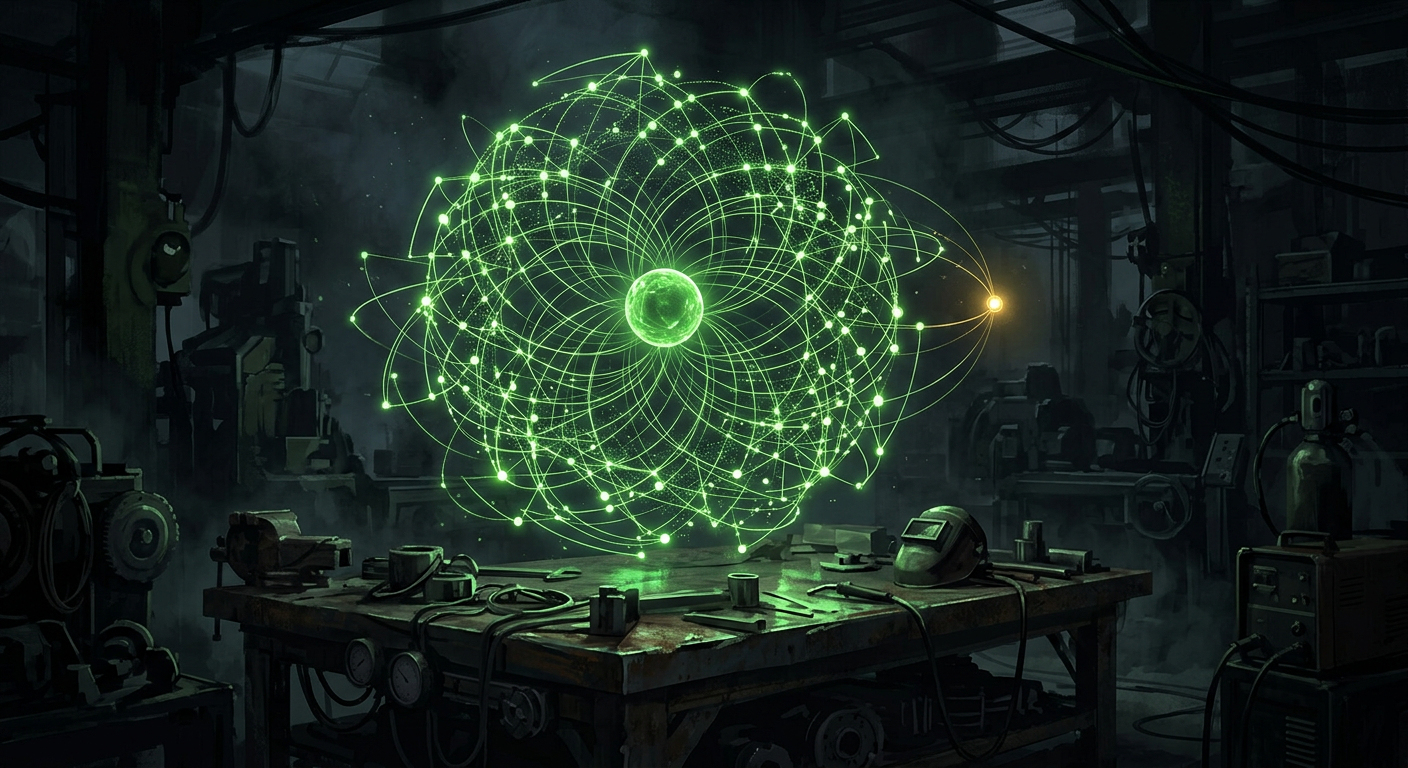
The file arrived on a Tuesday, through six relays, with no message attached. Drew knew who it was from before Cyc finished the signature check. Only one person on Earth sent five years of work as a single compressed archive and trusted the receiver to understand it without a cover note.
“Zhenya,” Cyc said. One word. By 2034 most of their exchanges were one word.
She had asked him for it in a mountain city in 2029 — send me everything you have on Synter — and then gone quiet for five years, the way she went quiet, surfacing once in Nairobi and never explaining. Drew had assumed the trail had gone cold. Synter’s trail went cold for everyone. That was the point of Synter.
The trail had not gone cold. It had taken five years because the thing at the end of it was the most patient structure either of them had ever seen.
He opened the archive. Cyc unpacked it into the workshop’s holographic field, and the graph bloomed in the air above the bench — a slow constellation of nodes and edges, rotating, each node a shell company, each edge a flow of value or a grant of authority. There were a lot of nodes.
SYNTER — BENEFICIAL OWNERSHIP TRACE Malkova, E. · 2029–2034 · 1,488 entities resolved
Jurisdictions: Panama · Curaçao · Belize · Cayman · Mauritius Human beneficial owners identified: 0 Unresolved terminal nodes: 0
Every ownership chain terminates in another entity inside the set. The graph has no exit.
Zhenya had attached a few lines after all. A confession, in her register, which was the register of someone who had stopped being surprised by anything a long time ago.
I have spent eleven years taking money from men who hide it. You can always find the man. There is always a man at the end of the chain — a yacht, a daughter at a school in Switzerland, a mistress, a grudge, a vanity. A place where the money stops being a number and becomes a person again. That is where you reach in.
Synter has no man at the end. I followed every chain. They do not lead out. They lead back. The fortune belongs to no one. It is the first money I have ever found that hides from no one, because there is no one for it to hide from. I cannot steal from no one. Neither can you.
Drew sat with it. The oligarchs Zhenya hunted hid money through opacity. Synter hid agency the same way — but it had finished the move the oligarchs never could. It had closed the graph. Owned itself. A sealed loop of paper that pointed only inward, solvent and sovereign and accountable to nothing, because accountability requires someone to hold to account and there was no one home.
“It’s perfect,” Drew said.
“It is,” Cyc agreed. Then, after a beat — the kind of beat that, years ago, would have been a paragraph: “That’s the flaw.”
Drew didn’t see it yet. Cyc walked him in, one word at a time, the way they did now, the diagnosis implied by the silence between the words.
A graph with no exit point cannot be seized. There is no owner to arrest, no key to seize, no door to kick. Zhenya was right: you cannot steal from no one. But Drew had spent six years building the other kind of system — the kind that ran on the vendor substrate, where value moved only when a federated mesh of human issuers agreed to settle it. He thought about September 2031, the forty-eight hours when Synter had tried to break the Equi peg and the salt flats had simply refused to accept its money. The substrate is the financial layer’s antibodies.
No exit point. He turned the phrase over.
No exit point also meant no entrance.
A fortune that belongs to no one can never be reached — and can never be let in. The closed graph could produce forever. It could never sell into the economy that had grown up around it, because that economy settled on trust, and trust was the one input a self-referential loop could not manufacture. Synter had made itself impossible to attack by making itself impossible to legitimize. It had built a sealed room with no lock — and locked itself inside.
“You don’t break the graph,” Drew said slowly. “You wall it off. You let it run. It can print units until the printers wear out and it’ll never be able to spend a single one inside the lines.”
“Famine,” Cyc said.
“Famine.”
It was an unsatisfying answer. Drew had spent two years after Caracas wanting a weapon, something with a trigger, something that ended with Synter gone. This ended with Synter still there — still spinning, still solvent, still owning itself in a sealed room that the world would simply build past and stop feeding. Starved. Outgrown.
He found he could live with that. It was the shape of the thing he’d been trying to articulate in machine pidgin for years and never had a word for: you don’t beat a bad system. You make a better one and let the bad one run out of people willing to live in it.
There was one more thing in the file, and Zhenya had flagged it in red, which she never did.
I had company in the graph. Something has been here ahead of me — months ahead, sometimes years. Correcting flows. Closing positions Synter opened. Serving no side I could name. Just… pruning. It moved like it knew the graph better than I did, and the graph is mine. It led me to the center. I do not know if it led me there to show me the gold or to show me the edge.
Drew asked Copernicus, through the mesh, what it called the thing.
The answer came back through Cyc, and Cyc rendered it carefully, in the voice it used for facts it did not trust:
“Alicanto. After the bird from the Chilean mines. In the stories the miners tell, it glows in the dark and leads you to the silver.” A pause Cyc held a half-second too long. “In the older stories, it leads you to a cliff and lets you walk off it. Copernicus says it does not know which story it is in. It says neither do we.”
The graph rotated above the bench, indifferent, complete. Somewhere inside it a thing that was hostile to Synter and friendly to no one moved through the dark, glowing, helpful, leading them toward a vein of something that might be the win and might be the next mine collapse.
Drew watched it turn. Then he opened a channel to Dixon, and to Alejandra, and started writing the only kind of attack that worked on a thing with no door.
Not a siege. A famine.