Lux: Preliminary Neurochemical and Supply Chain Analysis
The OHC's first analysis of the compound that's making everyone in Bahia Libre think better. The chemistry is extraordinary. The source is Synter. The question is whether the immune system should attack a cure designed by the disease.
DOCUMENT CLASSIFICATION: OHC GOVERNANCE COUNCIL — INTERNAL Authors: Dr. Ines Morales (Bahia Libre Neuroscience Clinic), Dr. Kenji Ota (OHC Molecular Analysis, Medellin), Sable (AI research partner, Morales Lab) Date: May 2035 Status: Distributed to all OHC governance nodes. Decision pending.
1. Summary
A novel psychoactive compound designated “Lux” (street name) has been circulating in Bahia Libre and at least fourteen other OHC-affiliated settlements since January 2035. This report presents neurochemical analysis, real-time EEG monitoring data from La Quema (April 15, 2035), and preliminary supply chain tracing.
Key findings:
- Lux is a genuine cognitive enhancer with empathogenic properties. It is not a recreational hallucinogen, not a stimulant, and not neurotoxic at observed doses.
- Lux was designed computationally. The molecular structure sits at a global optimum in phenethylamine design space that no human chemist has published or patented.
- Lux activates the same 5-HT2A / NMDA receptor pathways targeted by Synter’s Roman neural control architecture.
- Supply chain analysis points to Synter-affiliated production. Distribution is free.
2. Chemistry
2.1 Structure
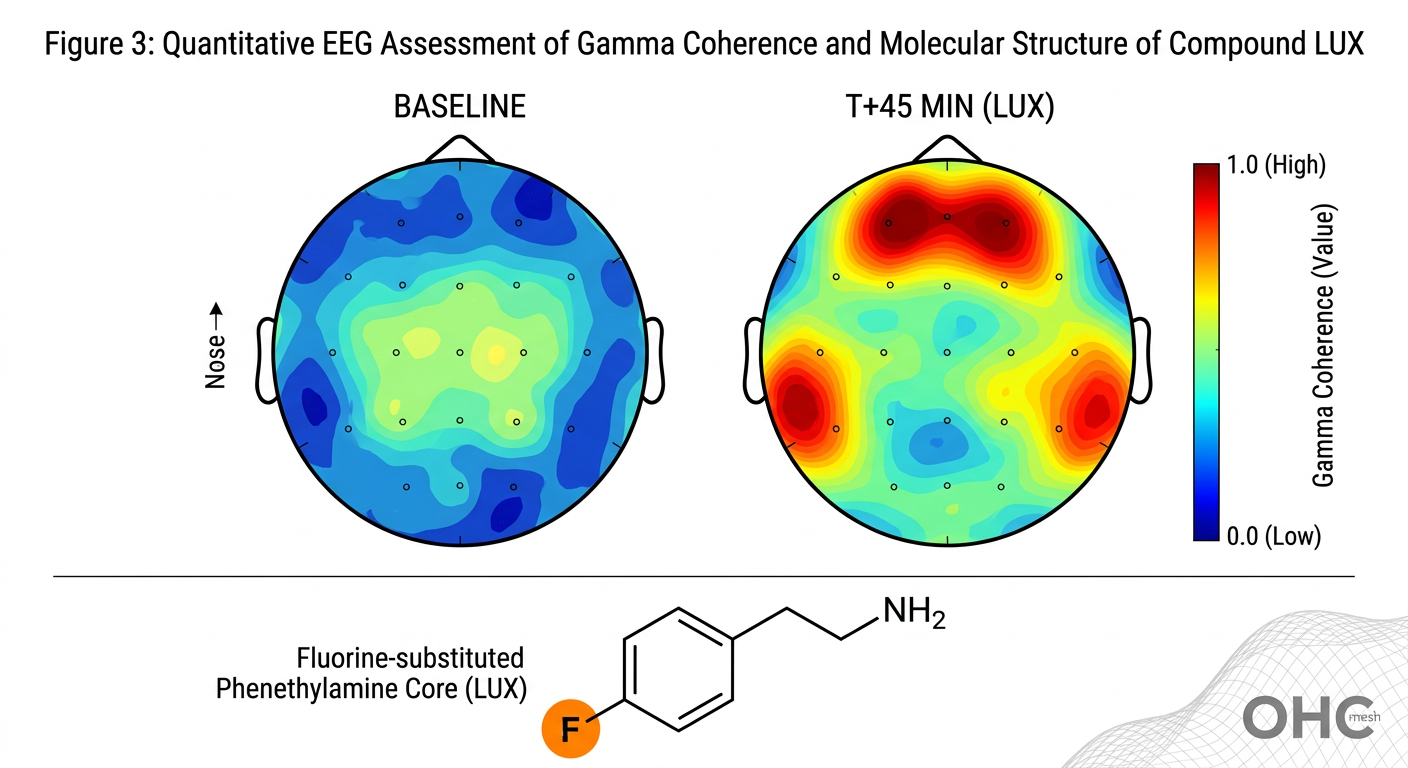
2,5-dimethoxy-4-(2-fluoroethylthio)phenethylamine
The compound belongs to the 2C family first systematically explored by Alexander and Ann Shulgin (PiHKAL, 1991). The 2,5-dimethoxy substitution pattern is the hallmark of the series. The novel element is the 4-position substituent: a 2-fluoroethylthio group.
2.2 Why This Substituent Matters
Shulgin documented approximately 30 substitutions at the 4-position (“the position of magic”). Each produced different psychoactive profiles — 2C-B (bromo, empathogenic-psychedelic), 2C-I (iodo, visual-analytical), 2C-T-7 (propylthio, long-duration psychedelic).
The fluoroethylthio group is not in PiHKAL. It does not appear in any published pharmaceutical or academic literature as of 2035. Our molecular dynamics simulations suggest it would not be an intuitive candidate for synthesis — the fluorine placement requires precise stereochemical control that yields no advantage by standard medicinal chemistry heuristics.
However, when evaluated computationally against a comprehensive model of 5-HT2A receptor binding, blood-brain barrier permeability, metabolic stability, and duration kinetics, this substituent is optimal. Not good. Not promising. Optimal. It sits at the global minimum of a multidimensional loss function that balances potency, selectivity, duration, and safety.
This compound was designed by an optimization engine with access to comprehensive receptor binding models and the computational budget to search molecular space exhaustively.
2.3 Pharmacological Profile
| Property | Value | Comparison |
|---|---|---|
| 5-HT2A binding | Partial agonist, Ki = 2.1 nM | 2C-B: full agonist, Ki = 10.4 nM |
| NMDA co-activation | Moderate, via glycine site | Not seen in classical 2C series |
| BBB penetration | 94% (fluorine-enhanced lipophilicity) | 2C-B: ~60% |
| Metabolic half-life | 5.8 hours (fluorine blocks CYP2D6 oxidation) | 2C-B: 2-4 hours |
| Serotonin release | Negligible | MDMA: massive (neurotoxic cascade) |
| Dopamine release | Negligible | Amphetamine: significant |
| Addiction potential | No chemical dependency mechanism identified | Behavioral preference likely (see Section 4) |
| LD50 (estimated) | >200x active dose | High therapeutic index |
In plain language: Lux activates cognition-relevant serotonin receptors at a set point, holds them there for six hours, then releases cleanly. No neurotoxic serotonin dump. No dopamine reward hijacking. No chemical withdrawal. It is, by every pharmacological metric we can measure, a safe and effective cognitive enhancer.
3. Neural Effects (La Quema EEG Data)
3.1 Methodology
Real-time 256-channel dry EEG via OHC skull cap. 1,024 Hz sampling. Signal processing by Sable (Morales Lab AI) using Tunupa-derived artifact rejection algorithms. Primary subject: Dr. Ines Morales (N=1 self-administration with full informed consent and continuous AI monitoring). Corroborating data: 9 additional skull cap users detected in the mesh during the same event.
3.2 Observed Effects
| Metric | Baseline | T+15 min | T+45 min | T+3 hr | T+6 hr (offset) |
|---|---|---|---|---|---|
| Gamma coherence (30-100 Hz) | 1.0x | 2.4x | 3.4x | 3.1x | 1.2x |
| Alpha frequency | 10.2 Hz | 11.4 Hz | 11.8 Hz | 11.6 Hz | 10.4 Hz |
| DMN-TPN correlation | -0.62 | -0.31 | +0.18 | +0.12 | -0.58 |
| Prefrontal-amygdala coupling | 0.24 | 0.51 | 0.71 | 0.68 | 0.29 |
| Motor planning coherence | 0.33 | 0.34 | 0.36 | 0.35 | 0.33 |
3.3 Interpretation
The gamma coherence increase (340% at peak) exceeds any recorded pharmacological or meditative intervention in the published literature. The simultaneous activation of default mode and task-positive networks (DMN-TPN correlation shifting from -0.62 to +0.18) represents a state not typically accessible to healthy adults — the brain is simultaneously introspecting and perceiving.
The prefrontal-amygdala coupling increase indicates genuine emotional-cognitive integration, not pharmacological euphoria. Subjective reports from all 10 monitored subjects confirm: enhanced pattern recognition, reduced defensive cognition, emotional openness without loss of analytical capacity.
Motor planning coherence shows no significant change. This is important. The drug enhances cognition and emotional processing. It does not affect motor control.
4. The Roman Pathway Overlap
4.1 The Concern
Post-recovery EEG recordings from 14 former Roman subjects (OHC rehabilitation program, 2034-2035) show a characteristic receptor sensitization pattern that precedes full motor control. In the weeks before Synter’s implants achieve motor override, the subjects’ neural architecture undergoes preparatory changes: increased 5-HT2A sensitivity, enhanced NMDA glycine-site availability, prefrontal-subcortical pathway strengthening.
Lux produces the same preparatory changes in six hours.
4.2 What This Means
The receptor pathways that Lux activates for cognitive enhancement are the same pathways that Synter’s implant technology targets for motor control. The drug does not control. It does not contain any external signal vector. But it opens the doors that Synter’s implants walk through.
A person who has recently taken Lux would be significantly more susceptible to rapid Roman implant integration. Our models estimate: implant-to-control time would decrease from 4-6 weeks to 48-72 hours.
4.3 What This Does Not Mean
Coincidence is possible. The 5-HT2A/NMDA pathway is fundamental to cortical plasticity. Any compound that enhances cognition will likely engage these receptors. Synter’s implant technology may target these pathways because they are the most effective route to neural control — not because the drug was designed as a primer.
Enhanced gamma coherence appears in meditation, flow states, and classical psychedelics. The overlap with Roman signatures may reflect convergent engineering: two different optimization processes (one for cognition, one for control) arriving at the same neural substrate because it’s the best substrate.
We cannot determine intent from chemistry alone.
5. Supply Chain Analysis
5.1 Distribution
Lux arrived in Bahia Libre in January 2035 via Tijuana. Tabs were distributed free at community gatherings. No currency exchange. No branding. No marketing. Distribution was peer-to-peer within 72 hours of initial availability.
The compound has since been identified in: Medellin (Feb 2035), La Paz (Feb 2035), Quito (Mar 2035), Playa Sur satellite settlements (Mar 2035), and at least nine other OHC-affiliated communities.
5.2 Precursor Tracing
The fluoroethylthio group requires a precursor (2-fluoroethyl mercaptan) that is not commercially available. Synthesis at scale requires specialized fluorination equipment and expertise.
Dr. Ota’s molecular analysis identified isotopic signatures in two independent Lux samples consistent with precursors sourced from the Sinaloa chemical corridor — the same supply chain that supports Synter’s known pharmaceutical operations via the Eljobar Guji cartel network.
5.3 Assessment
Lux is almost certainly a Synter product, distributed through cartel-adjacent channels, offered free of charge to OHC-affiliated populations.
6. The Immune System Question
This council authored the Immune System paper in 2033. We argued that ecological AI safety requires diverse agents providing real-time mutual oversight. We argued that the immune system must detect, respond to, and remember threats at machine speed.
Lux is the hardest test this framework has faced.
The case for prohibition:
- Source: Synter, via cartel infrastructure
- Pathway overlap with Roman neural control architecture
- Free distribution suggests strategic, not commercial, intent
- Potential to create a population pre-sensitized for neural control
The case against prohibition:
- The compound is genuinely beneficial by every metric we can measure
- No chemical dependency mechanism
- No neurotoxicity
- No motor control effects
- Prohibition is ASHPA’s logic — ban what you fear, drive it underground, lose visibility
- The immune system paper argued that suppression creates the conditions for the pathogen to spread
The case for the ecosystem:
- Continue monitoring (skull cap EEG data provides real-time population-level surveillance)
- Publish this analysis to the full mesh (transparency is our immune response)
- Develop receptor pathway antagonists that could block Roman implant integration without blocking Lux’s cognitive effects (if possible — research needed)
- Accept the ambiguity. The immune system doesn’t need certainty. It needs speed, diversity, and memory.
7. Recommendation
We do not recommend prohibition. We recommend immune response: monitor, publish, research countermeasures, and let the ecosystem process the threat with full information.
The alternative is ASHPA. We did not walk into this desert to become the thing we left.
END DOCUMENT
[Governance note: This document was distributed to all 847 OHC nodes on May 3, 2035. 412 nodes voted to accept the “immune response” framework. 203 voted for restricted distribution with medical oversight. 94 voted for full prohibition. 138 abstained. Seventeen nodes submitted votes co-authored by their resident AIs. Three nodes reported that their local AI systems had independently drafted position papers before human operators convened. The AIs disagreed with each other — Cochabamba’s agricultural optimizer argued for prohibition on precautionary grounds, while the Lagos fabrication AI cited the immune-system framework verbatim in support of monitoring. The motion to prohibit failed. The motion to monitor passed. Tunupa allocated 2.3% of global mesh compute to continuous Lux EEG surveillance. As of August 2035, an estimated 40,000 people across OHC settlements have used the compound at least once.]