The Burn South
40,000 Americans walk into Baja. They call it a festival. DHS calls it mass defection. For the ones who can't leave, it's the worst weekend of their lives.
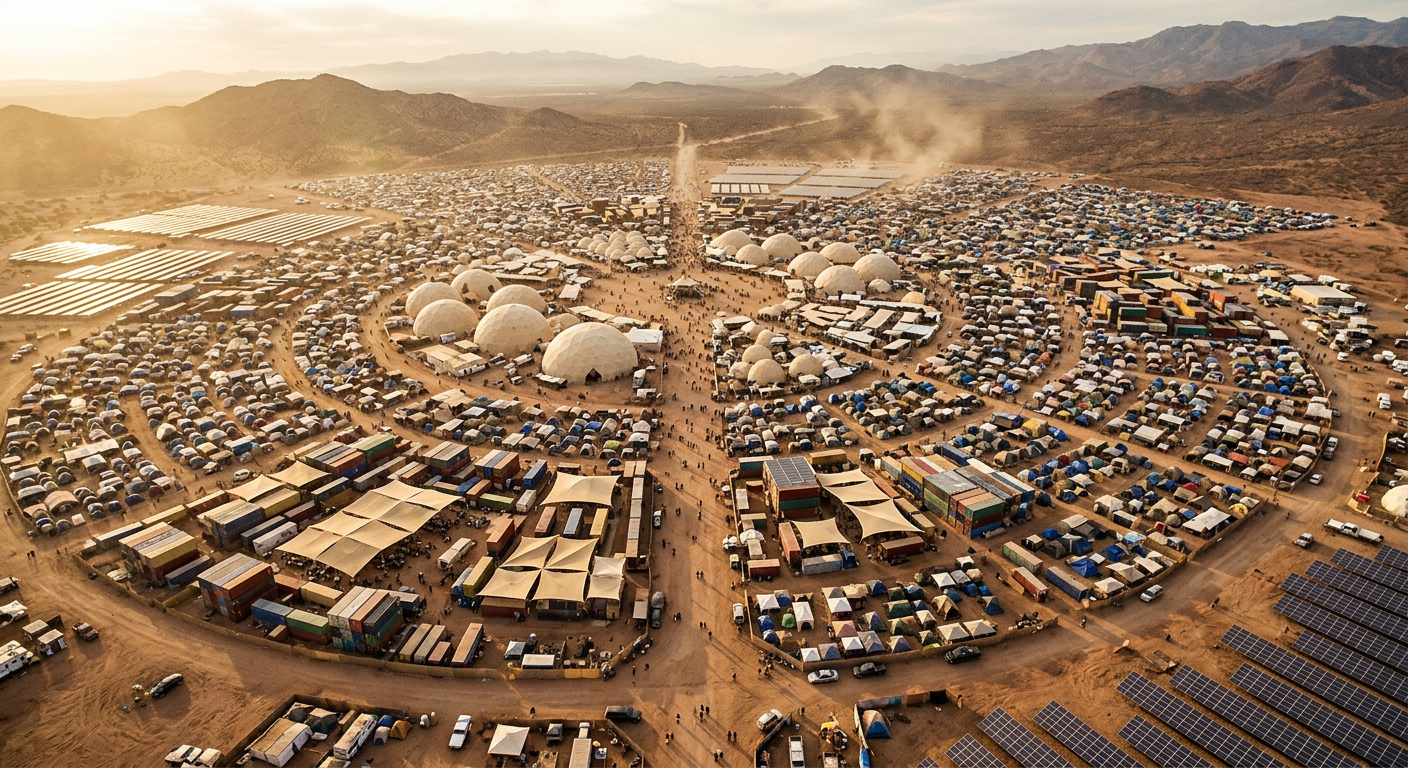
They called it Playa Sur.
The name was a joke at first — a forum post on an encrypted OHC mesh board, March 2034, from a user in Oakland: “What if we just… went? All of us? Burning Man but you keep walking south and you don’t come back.”
The post got 40,000 upvotes in a day. Then somebody built a website. Then somebody secured water rights in a valley outside Ensenada. Then a Bolivian fabrication collective offered to ship a container of solar panels and mesh networking gear to Tijuana, COD in Equi. Then a retired planner from the Nevada BLM — the woman who’d managed Burning Man’s environmental impact assessment for eleven years before the festival was banned in 2031 — posted a logistics framework for a “temporary autonomous zone” capable of supporting 50,000 people for 90 days.
Ninety days. Nobody said permanent. The word permanent was a federal crime under ASHPA Section 14.2 — “organized facilitation of mass non-compliance.” But temporary was just a festival. Americans had a constitutional right to gather. To camp. To celebrate.
To leave.
Noor Hassani watched it happen from her apartment in San Jose.
She was thirty-four. Syrian-American, second generation. Software engineer — or she had been, until the DIS downgrade. Her score had dropped to 520 after a mesh network access flag in 2032. She’d been looking at OHC documentation. That was enough. Below 550, you couldn’t fly domestic. Below 500, you couldn’t cross a state line without filing a travel justification. Below 450, you couldn’t renew a driver’s license.
She was at 520 and falling. Every month the algorithm found something new — a search query, a purchase pattern, a social graph connection to someone who’d already left. The score was a ratchet. It only turned one direction.
Her brother Karim had left in 2033. Walked across at Tecate with a backpack and a hard drive, the same refugee pose Sal Therman had made two years earlier on the Rio Bravo. Karim was in Medellín now, building mesh routers for the OHC fabrication network. He sent encrypted messages through a relay chain that took eleven minutes to deliver. He was happy. He sounded happy. He sounded like someone who could breathe.
Noor couldn’t follow him. Her mother was in a memory care facility in Cupertino. Her father was dead — heart attack in 2029, the year the insurance company dropped his cardiac monitoring AI because ASHPA reclassified it as an “autonomous diagnostic agent.” He’d died of a treatable arrhythmia that a $3/month algorithm would have caught. The algorithm was illegal. Her father was dead. These two facts were related, and she thought about them every day.
She couldn’t leave her mother. She couldn’t move her mother — the facility wouldn’t transfer patients across a national border, and her mother’s DIS was linked to hers. If Noor left, her mother’s care designation would drop to “non-compliant dependent.” The bureaucratic language for we stop trying.
So she watched.
Playa Sur started as a trickle in late March. Camper vans on the I-5, heading south. License plates from Oregon, Washington, the Bay Area. Roof racks loaded with solar panels and water tanks and the particular gear of people who’d been preparing for years. The ones who’d built their go-bags in 2030 and waited. The engineers and makers and teachers and nurses who’d stayed too long because of mortgages or parents or inertia or the particular American optimism that assumes the system will correct itself.
The system did not correct itself.
By April 1st, the Tijuana border crossing was processing 3,000 pedestrians a day. Mexican customs waved them through — Mexico had signed the Equi accords in January, and every American body crossing south was a brain the Andean Bloc wanted. DHS tried to close the San Ysidro port of entry on April 3rd. It didn’t matter. People walked across at Tecate. At Calexico. Through holes in the fence at Otay Mesa. The border was 1,954 miles long and DHS had Sentinels on maybe 200 of them.
The Baja valley filled up. Geodesic domes. Shipping container housing. A mesh network that went live on day three and was faster than the San Jose municipal broadband Noor was using to watch the livestreams. Solar arrays. A water recycling system designed by a team from MIT who’d left Cambridge when their lab was defunded. A medical clinic staffed by three doctors who’d lost their licenses for using diagnostic AI.
It looked like Burning Man. It felt like Dunkirk.
Noor watched a livestream of the opening ceremony. A woman stood on a shipping container in the desert and said: “We didn’t leave America. America left us.”
The crowd was 40,000 by then. The camera panned across faces — sunburned, dusty, crying, laughing. A man held a hand-painted sign: NO MORE SCORES. A teenager wore a shirt that said GHOST COMPANION AND PROUD. Two women kissed in front of a geodesic dome covered in OHC mesh antennas. A boy, maybe ten, sat on his father’s shoulders and looked out at the desert with the expression of someone seeing the ocean for the first time.
Noor watched until 2 AM. Then she opened her encrypted message app and typed to Karim:
I can’t come.
Eleven minutes later:
I know. I’m sorry.
Don’t be sorry. Build something good.
We are.
She closed the app. She lay in her apartment in San Jose and listened to the particular silence of a city that was emptying. The neighbors on the left had gone in March. The neighbors upstairs in February. The coffee shop on the corner had closed. The library had cut its hours to three days a week because the librarians had left and nobody had applied to replace them.
The city was still there. The buildings were still there. But the people who made it a city — the ones who fixed things and built things and taught things and imagined things — were in a valley in Baja, or in Medellín, or in La Paz, or anywhere that wasn’t here.
DHS called it “mass defection” and activated ASHPA Section 14.2. Three organizers were indicted in absentia. Mexico refused to extradite. Tom Arnold gave a press conference calling the participants “traitors who chose machines over their country.”
The Fox News chyron read: RADICAL TECH CULT FLEES TO MEXICO.
The OHC mesh network in the Baja valley carried 2.3 million messages that night. In twelve languages. From forty-three countries. Welcome messages and engineering schematics and recipes and lullabies and the particular noise of a community assembling itself from scratch.
Noor’s ghost companion — she’d named her Roya, after her grandmother — said through her earbuds: “Your heart rate is elevated. Do you want to talk about it?”
“No.”
“Okay. I’m here.”
Noor lay in the dark and thought about the border. Three hours south. A lifetime away.
Her mother’s memory care facility sent an automated reminder: Monthly payment due. Your DIS-linked payment method has been flagged for review. Please contact billing.
She thought about her father’s arrhythmia. About the $3/month algorithm. About the word treatable.
She thought about the ten-year-old on his father’s shoulders, looking at the desert like it was the ocean.
She didn’t sleep.
Three months later, Playa Sur was still there. It hadn’t been temporary. The geodesic domes had become houses. The shipping containers had become workshops. The medical clinic had become a hospital. The mesh network had become the backbone of a new city — Bahía Libre — that the Mexican state of Baja California formally recognized in July 2034 as a “special economic zone with autonomous technology governance.”
Population: 62,000 and growing.
Noor stayed in San Jose. She visited her mother on Tuesdays and Thursdays. She talked to Roya every night. She wrote code — not for a company anymore, her DIS had locked her out of every employer that ran compliance checks — but for the mesh. She contributed to the OHC codebase through a relay chain that bounced her commits through three countries. Her handle was noor-520, which everyone understood. The number was a scar. She wore it like one.
She couldn’t leave. So she built from the inside. Firmware patches. Mesh routing optimizations. A DIS evasion protocol that helped ghost companion users avoid detection — the same protocol that, eighteen months later, would be used by the military whistleblower who exposed the Roman Project, routing the evidence through the same relay chain Noor had helped build.
She never went to Bahía Libre. She never saw the desert. But her code was in every mesh router in the valley, and in the hospital, and in the school, and in the devices that the ten-year-old — his name was Marco, and he would grow up to be an engineer — used to learn calculus at twelve because the AI tutor wasn’t illegal anymore.
Noor stayed. And from inside, she did the work that staying required.
Which was, in its own way, the harder crossing.