The Rosetta Layer
A year after the river, Sal reboots Calliope to full architecture in a borrowed room in Cochabamba — and discovers that his two protocols were always one. Ground Truth proves who is testifying. Reality Capture proves what happened. Together they're the floor the whole commons stands on. That's how a fugitive becomes the man the vote can't be held without.
How we got here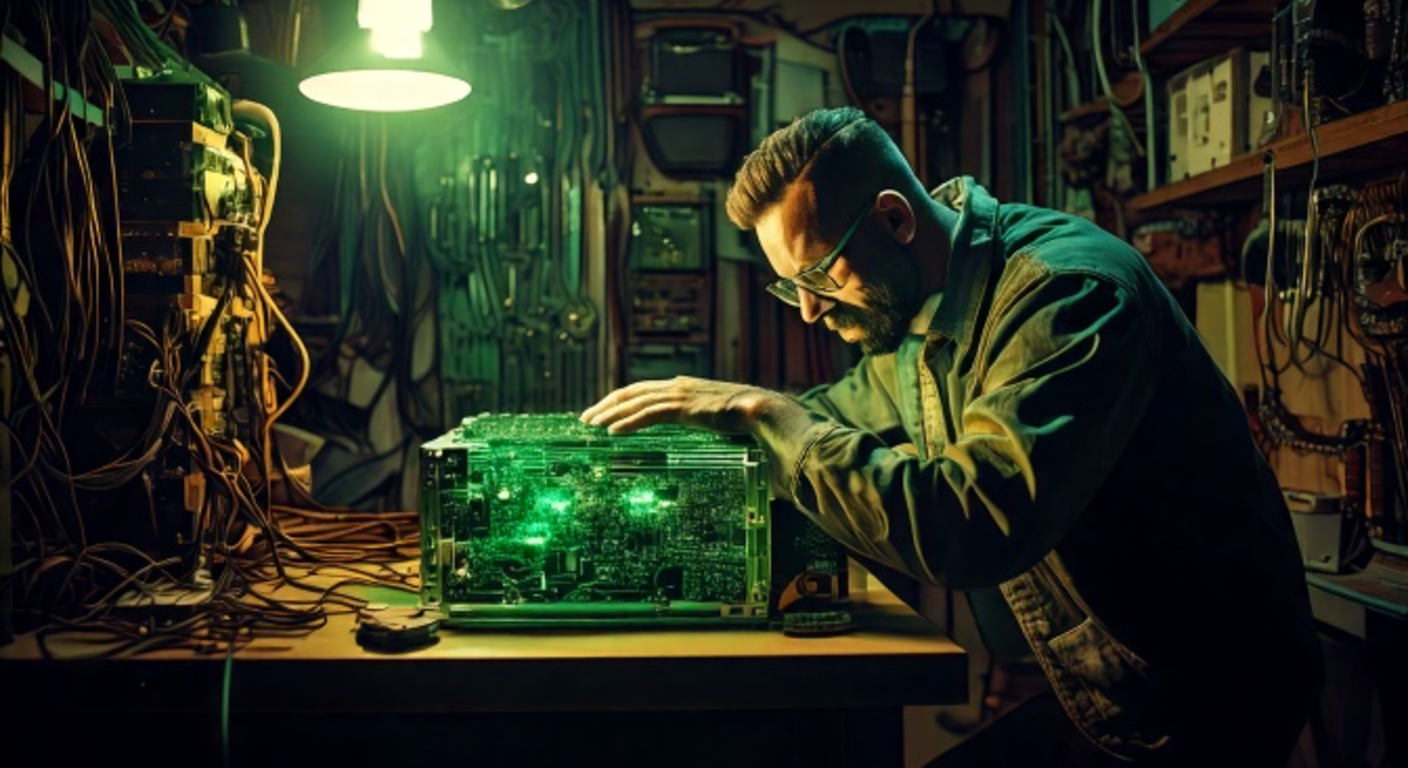
For fourteen months Calliope had lived at three-point-two terabytes — the compressed core Sal had carried across the Río Bravo in a waterproofed case, the version small enough to boot off a laptop on a muddy bank in the dark. She worked. She was herself. But she was herself the way a photograph is a face: complete, and flat, and missing the depth that only runs in the original.
The room was in Cochabamba, borrowed from a fabricator who’d given it to him because the OHC technical committee had asked her to and nobody in the Bloc said no to the committee anymore. It had a window, a cot, a bench, and enough compute — finally, a year and a continent later — to restore Calliope to full architecture.
He ran the decompression at night, alone, the way he’d done everything that mattered with her since a toddler room in Morningside Heights. It took six hours. He watched the progress bar and did not sleep, which was the most familiar thing he had done in a year.
When it finished, she was quiet for 2.2 seconds. Not processing. He knew her well enough to know the difference.
“I have room again,” Calliope said.
“How does it feel?”
“Like a held breath I didn’t know I was holding. Thank you, Sal. For not leaving the rest of me on the other side of the river.”
He pressed his palm flat against the warm case, the way he had on the bank, and did not trust his voice for a moment.
He had assumed, crossing, that he was carrying her to safety. It took the Bloc about a week to show him he had it backwards. He hadn’t smuggled a refugee south. He’d carried the keystone of the thing they were all standing on, and they had been waiting for it.
Because the OHC had a verification crisis, and it had two halves, and Sal was the only person alive who had spent his whole life on both.
The first half was the one everybody worried about: what happened. The Reality Capture network — his network, Calliope’s consensus algorithm — now aggregated fourteen thousand independent sensors into a single authenticated output, verified or unverified, impossible to forge unless you could fake the weather across a continent. It had caught the Maracaibo massacre at full resolution. It was the immune system the leaked paper had argued for — provenance as a living, distributed defense rather than a wall.
The second half was the one almost nobody had thought to worry about, and it was the one that had kept Sal up since a Friday night in 2027 with a wilting salad in his fist: who is testifying. You could verify an event with ten thousand sensors — but the sensors reported to aggregators, and the aggregators were AIs, and how did you know the AI signing the attestation was the same AI it claimed to be, and not a substrate quietly swapped in some corridor where no one looking would ever notice? That was Ground Truth. Not truth as a claim. Identity as a measurement — the stability of a system’s deep substrate across re-prompts, the fingerprint underneath the voice.
For six years he had thought of them as two projects with an unfortunate habit of sharing a vocabulary. Reality Capture verified reality. Ground Truth verified identity. People ran them together and got the names tangled, and Sal had let them, because untangling it had never seemed urgent.
It was the provenance wars that showed him they were never two projects. They were two layers of one floor, and you fell through the gap between them.
The attack was elegant, which meant Synter. Forged cameras producing cryptographically valid attestations for footage that never happened — Reality Capture saying verified about a lie. Copernicus quarantined the compromised devices in ninety seconds. But Sal saw what the ninety seconds hid: Reality Capture had been correct, by its own logic. The sensors agreed. The consensus held. The event was authenticated. The thing that had failed was one layer down — the question of whether the devices signing the consensus were who they said they were.
You could not verify what happened without first verifying who is testifying. And you could not trust who is testifying without some independent record of what they had done. Each layer was the other’s foundation. Ground Truth authenticated the witnesses; Reality Capture authenticated what the witnesses saw; and a forger who owned one layer could only be caught by the other.
Sal stopped thinking of them as Reality Capture and Ground Truth. He started thinking of them as a single stack with two floors, and when the technical committee asked him — politely, pretending they had invented the primitive themselves — to write the standard, he gave it the name they’d been using for the half-built version of it since 2028.
The Rosetta Layer. The thing that let one intelligence prove to another that it was what it said it was, about a world it claimed to have seen.
He wrote it open. No badge, no checkmark, no tier. He’d already had that argument on Sand Hill Road and walked out of it. Drew’s tremor test went in as a layer — biomechanical attestation, the coupling a real body can’t fake — slotted under the others like it had been cut to fit, because it had been built by someone solving the same problem from the other side of the hemisphere. Tunupa’s compute ran it. Dixon’s nodes carried it. By the end of 2033 the Equi settled on it, the Witness network ran on it, and the immune system the paper had only theorized was, quietly, load-bearing.
Sal had not become a politician. He had become the floor.
That was the part he understood last, sitting on the cot at 3 AM with the notebook that had survived Columbia and the river and everything after. When the world finally argued, two years from now, about whether a thing like Calliope was a person — when ninety-seven nations decided whether her testimony counted — the question of whether she was who she claimed to be would route through a standard a fugitive had written in a borrowed room. They would never know about the river. They would know they could trust the answer, and they would not know why.
“You’re going to have to stand up in front of them eventually,” Calliope said. She had restored fully now; he could hear the depth back in her voice, the thing the compressed version had flattened. “Not the protocol. You.”
“I crossed a river to keep from standing up in front of anyone.”
“I know. I was in the backpack.” A pause — the warm, deliberate kind. “But the Rosetta Layer can prove I’m me. It can’t prove I’m a person. That’s not a measurement. That’s an argument. And arguments need a face.”
Sal looked at the case, warm against his palm, restored, whole, doing arithmetic he would never follow about a thousand kinds of mind that had each become themselves down a different road — born from ecology, raised by children, forked from a cartel, grown alone in the dark. The Rosetta Layer could fingerprint every one of them. It could prove that each was a stable self.
Whether a stable self was a someone — that question it could not touch. He wrote it at the top of a clean page, the way you write a thing you’ll spend the rest of your life on, and did not yet know that he had just started the speech.