The Nairobi Stack
James Ochieng builds an Equi layer on top of M-Pesa. Overnight, 30 million Kenyans can spend a currency the US has sanctioned. The Andean Bloc economists didn't design for this. Zhenya's math holds. Barely.
James Ochieng had never met Zhenya Malkova. He didn’t know her name. He knew her work — the lattice-based verification scheme that underpinned the Equi — the way a plumber knows the municipal water system: by its pressure, its capacity, its failure modes. He’d read the cryptographic specification. He’d stress-tested it against simulated loads. He’d found the bottleneck.
“The verification throughput caps at 340 transactions per second,” James told the council on a mesh call from his apartment in Westlands, Nairobi. “That’s fine for the current Equi network — 8 million users, average transaction frequency of 0.3 per day. It is not fine for what I’m about to do.”
“What are you about to do?” asked Alejandra, from La Paz.
“M-Pesa processes 1,100 transactions per second at peak. Forty-seven percent of Kenya’s GDP flows through it. If I bridge the Equi to M-Pesa, the verification layer needs to handle at least 800 transactions per second on day one, and 2,000 within six months.”
Silence on the call. James could hear the mesh relay hum — the slight latency of a connection bouncing through seven nodes between Nairobi and La Paz.
“The verification scheme wasn’t designed for that throughput,” Alejandra said.
“I know. That’s why I’m telling you before I deploy, not after.”
James Ochieng was thirty-four. Born in Kisumu, on the shore of Lake Victoria. BSc in computer science from the University of Nairobi — a program that produced more mobile payment engineers per capita than MIT, because in Kenya, mobile payment engineering wasn’t an academic specialty. It was survival. M-Pesa launched in 2007. By the time James entered university in 2016, half the country’s economy ran on it. You didn’t study mobile payments at UoN. You studied everything else, and mobile payments was the substrate.
After university: three years at Safaricom, the telecom that operated M-Pesa. James worked on the transaction settlement layer — the system that reconciled 28 million daily transactions between mobile wallets, bank accounts, and agent float. He understood M-Pesa the way Luana understood metallurgy: not as an abstraction but as a physical system with latencies and failure modes and the particular texture of real money moving through real infrastructure.
He’d left Safaricom in 2029 — the same year the OHC reached Nairobi — because Safaricom had signed a data-sharing agreement with a consortium that included, three shell companies deep, a DHS contractor. Kenyan transaction data flowing to American surveillance infrastructure. James couldn’t prove the connection. He could smell it. He’d spent three years reading transaction logs. He knew what a clean data flow looked like. This wasn’t clean.
The OHC offered something different. Not better — different. A payment system that didn’t require trusting the operator, because the operator was math. Zhenya’s lattice verification didn’t care who ran the node. It verified the physics. Lithium produced, energy generated, value created — measured, hashed, anchored. Trust was a computation, not a relationship.
James understood why this mattered. He’d grown up in a country where the payment system worked and the government didn’t. Where 47% of GDP flowed through a private company’s servers because the state-run banks were corrupt, slow, and intermittently solvent. M-Pesa wasn’t a technology story. It was a trust story. Kenyans trusted Safaricom more than they trusted the Central Bank of Kenya. Not because Safaricom was trustworthy — because Safaricom was functional.
The Equi was the next step. Trust that didn’t require trusting anyone. But the Equi, as designed, required OHC hardware — mesh relays, dedicated wallets, fabrication-node infrastructure. In Cochabamba, where the OHC had density, this worked. In Nairobi, where the OHC had forty-three nodes across a metro area of 10 million people, it didn’t. You couldn’t ask 10 million Kenyans to adopt new hardware. You had to meet them where they were.
Where they were: M-Pesa. Feature phones. SMS. The simplest possible interface to the most sophisticated possible cryptography.
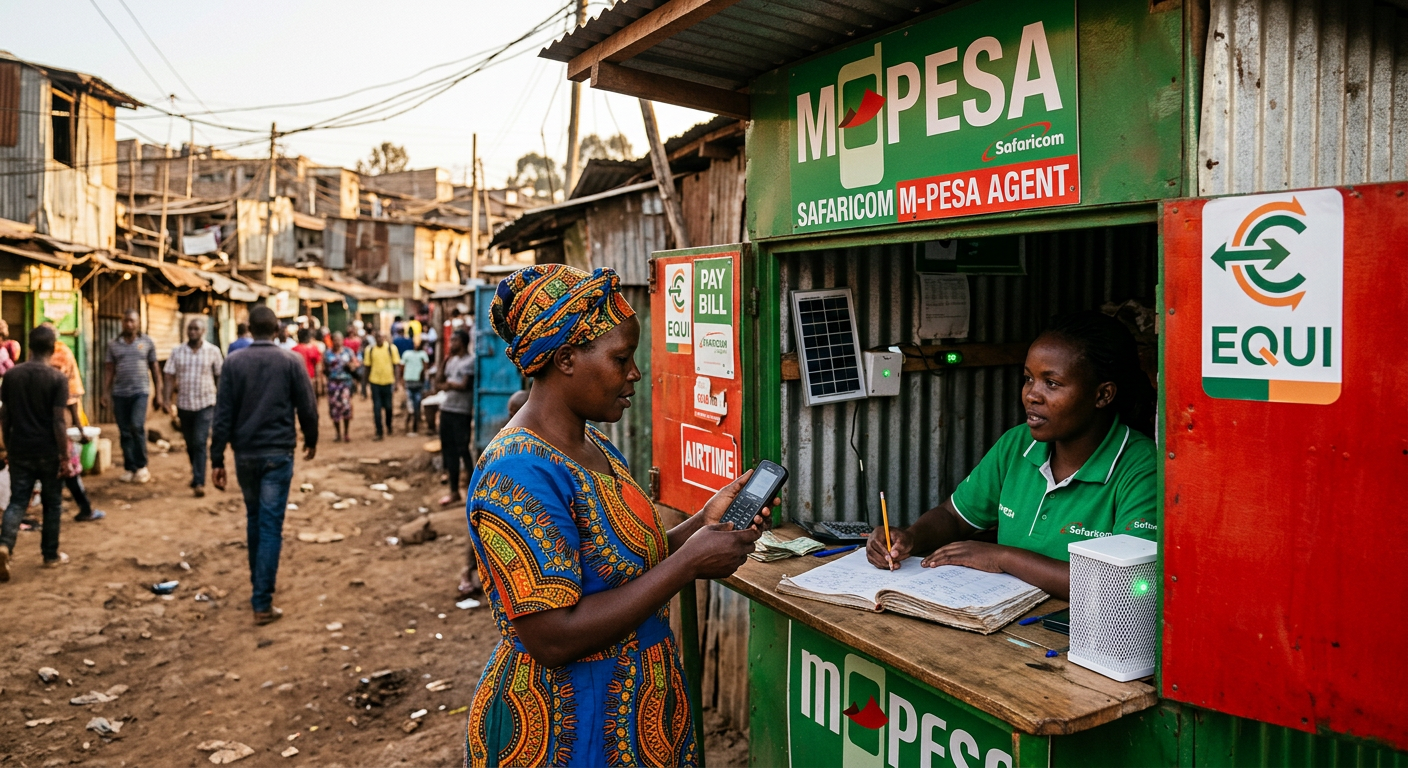
The bridge was elegant. James built a lightweight verification client that ran on Safaricom’s USSD infrastructure — the same text-menu system that M-Pesa used. A user dialed *384#, entered an amount, and the system converted their M-Pesa balance to Equi at the current exchange rate. The conversion didn’t move money to a blockchain. It didn’t require a wallet app. It settled through M-Pesa’s existing ledger, with the Equi verification running as a parallel attestation layer — a cryptographic receipt that proved the transaction was real without requiring the user to understand the math.
The brilliance was in what it didn’t require. No smartphone. No internet connection. No OHC hardware. A farmer in Nyeri with a ten-year-old Nokia and intermittent GSM coverage could hold Equi-denominated value and spend it at any M-Pesa agent — 247,000 agents across Kenya, more locations than all the banks and ATMs in the country combined.
The bottleneck was Zhenya’s verification layer. Each Equi transaction required a lattice-based proof — a computation that, on OHC mesh hardware, took 12 milliseconds. James’s bridge needed to generate these proofs at M-Pesa scale: 1,100 per second at peak. The mesh nodes in Nairobi didn’t have the compute. The latency budget was 200 milliseconds end-to-end, or M-Pesa users would notice the delay and stop using the bridge.
James solved it by cheating. Not cheating the cryptography — cheating the architecture. Instead of verifying each transaction individually, he batched them. Every 500 milliseconds, the bridge collected all pending transactions, computed a single aggregated proof for the entire batch, and settled them simultaneously. A Merkle tree of transactions, verified by a single lattice proof, settled in a single M-Pesa ledger entry. The individual transaction receipts were derived from the batch proof — mathematically valid, individually verifiable, but computed collectively.
Throughput: 2,400 transactions per second. Latency: 180 milliseconds average. Compute cost: fourteen OHC mesh relays running verification at full capacity, drawing 340 watts total — less than a desktop computer.
He sent the specification to the council. And to Zhenya, through the mesh, through the zero-knowledge relay that meant he couldn’t know who she was or where she was — only that the verification scheme bore her cryptographic signature.
The response came in six hours. Not from Zhenya — from Cyc, relaying on her behalf.
The batch construction is valid. I
verified the proof derivation. The
Merkle aggregation preserves the
security guarantees of the individual
proofs.

Two concerns:

1. Batch settlement creates a 500ms
window in which transactions are
pending but unverified. During this
window, a double-spend attack is
theoretically possible. Probability
at current Equi liquidity: 10^-9
per batch. Acceptable.

2. If adoption reaches 30M users
(Kenya + Tanzania + Uganda), batch
sizes will exceed the current Merkle
tree depth limit. Increase the tree
depth from 16 to 24 levels. This
costs 3ms additional compute per
batch. Worth it.

Deploy.
The bridge launched on April 8, 2032. James had coordinated with Kehinde in Lagos — the M-Pesa bridge was technically specific to Safaricom’s system, but the architecture was portable. MTN Mobile Money in Nigeria, Airtel Money in Uganda, Tigo Pesa in Tanzania — all used similar USSD infrastructure. The bridge was a template, not a product.
Day one: 847,000 transactions. Day seven: 3.2 million. By the end of the month, 19 million Kenyans held Equi-denominated balances on their M-Pesa accounts.
The economics were immediately visible. The Kenyan shilling had been losing value against the dollar for a decade — inflation, trade imbalance, the usual developing-economy pressures. The Equi, backed by Andean Bloc lithium and fusion output, was gaining. Kenyan farmers who sold their harvest for shillings watched the value erode by 2% per month. Kenyan farmers who sold their harvest for Equi watched the value hold.
Word spread the way things spread in Kenya — not through apps or advertising but through the agent network. The M-Pesa agents — the shopkeepers and kiosk operators who handled cash-in and cash-out — became de facto Equi exchange desks. They’d buy Equi low, sell high, pocket the spread. The spread was tiny — 0.3% on average — but on 3.2 million transactions per day, it added up. The agents didn’t understand lattice-based cryptography. They understood margins.
The Andean Bloc economic council watched the numbers with something between pride and panic. Pride: the Equi was working. The currency they’d designed was being adopted by 19 million people who’d never heard of Cochabamba. Panic: 19 million people were using the Equi in ways the economic council hadn’t modeled. The monetary policy assumptions — velocity of money, transaction frequency, liquidity depth — were calibrated for 8 million users with OHC wallets. Not for 19 million users with feature phones buying maize flour at roadside stalls.
“The tail is wagging the dog,” said the council’s lead economist, a Chilean named Rodrigo Espinoza, during an emergency session.
“No,” said James, who was attending his first council meeting via mesh relay. “The dog just got bigger. Your tail is the same size. That’s the problem you need to solve, not the growth.”
Kehinde, from her Lagos seat, said nothing. She was watching the fabrication orders — mesh relay demand from East Africa had tripled in a week. The Nairobi stack needed compute. Compute needed hardware. Hardware needed the supply chain she controlled.
The network was rebalancing. Not by design. By use.
The US sanctioned the Equi six weeks later. Executive Order 15340: “Prohibition on Transactions in Unregistered Digital Currencies Facilitating Circumvention of Lawful Financial Sanctions.” The order made it illegal for any US person or entity to hold, transact, or facilitate transactions in Equi-denominated instruments.
The order had no effect on Kenya. Or Nigeria. Or Tanzania. Or the forty-three other countries where the Equi was now circulating. The US had sanctioned a currency used by 30 million Africans who had never held a dollar and never would. The sanction was a message — not to Africa, but to American banks, American companies, American citizens who might consider the Equi as an alternative to a dollar that was losing value against a currency backed by lithium and fusion.
James read the executive order on his phone, standing outside a M-Pesa agent kiosk in Kibera — Nairobi’s largest informal settlement, one million people, 2.5 square kilometers, and as of that morning, 340,000 Equi wallets.
He put the phone away and watched a woman buy cooking oil with Equi, settled in 180 milliseconds through a system built by a Russian cryptographer, validated by a Bolivian AI, bridged by a Kenyan engineer, and running on hardware fabricated from recycled phones in Lagos.
The US had sanctioned this. The woman buying cooking oil didn’t know and wouldn’t have cared.
The network was growing. Not because anyone planned it. Because it worked.