The Lagos Pivot
Kehinde's Alaba operation has outgrown Cochabamba. She's not recovering chips anymore — she's fabricating at scale. She demands a council seat. The vote splits the OHC down its oldest fault line: who designs, and who builds.
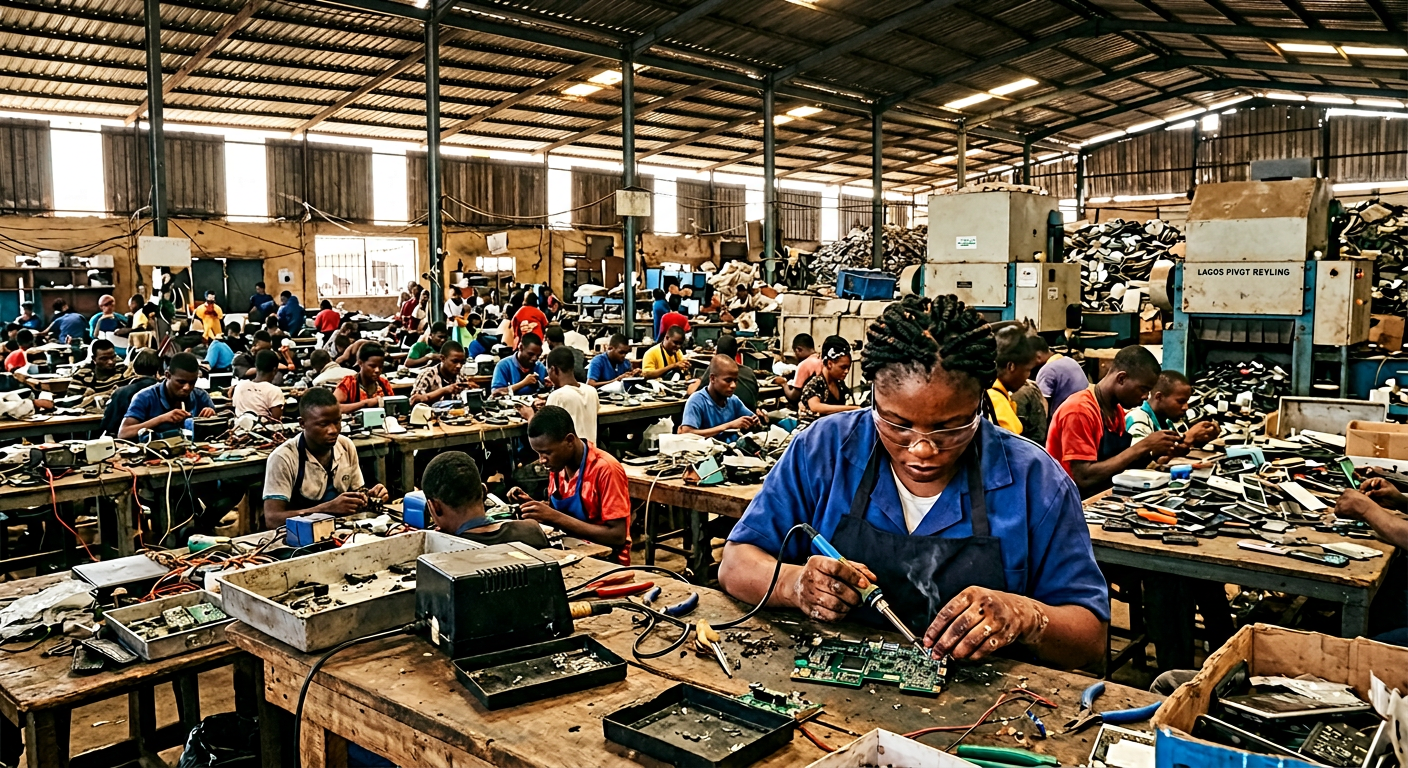
The numbers arrived on Dixon’s terminal at 4:17 AM Oakland time. Copernicus flagged them as anomalous, which was Copernicus’s way of saying: pay attention.
Lagos Alaba cluster: 847 E-Eater units operational. Monthly throughput: 312 metric tons of e-waste processed. Material recovery: 28 tons copper, 890 kilograms tin-lead solder, 14.2 kilograms gold, 4.1 kilograms palladium, 2.3 tons rare earth concentrates. Fabricated output: 94,000 printed devices — mesh relays, sensor modules, Witness cameras, power management units, and a category Copernicus listed as “unclassified.”
Dixon read the numbers twice. Then he called up the Cochabamba cluster for comparison.
Cochabamba cluster: 203 E-Eater units. Monthly throughput: 74 metric tons. Fabricated output: 31,000 devices.
Lagos was producing three times the output of the OHC’s founding city. And the “unclassified” category — Dixon pulled the specs — was a new device type that hadn’t come from Cochabamba’s design library. A ruggedized mesh relay with an integrated solar charging circuit, optimized for equatorial sun angles and the specific harmonic interference pattern of Lagos’s overloaded electrical grid. The thermal management used a passive cooling geometry that Copernicus hadn’t designed. Someone had designed it locally.
Dixon knew who.
Kehinde Alabi had not asked permission. This was, depending on your perspective, either the most OHC thing she could have done or the least.
The OHC’s founding principle — written into the manifesto that Dixon himself had drafted — was that fabrication knowledge should be open, distributed, and locally adapted. Any node could modify any design. Any node could fabricate any device. The network was not a franchise. It was a commons.
But the commons had a center. The firmware came from Cochabamba. The AI — Copernicus for fabrication, Tunupa for validation — ran on Andean Bloc infrastructure. The Equi was governed by the Andean Bloc’s economic council. The design library was curated by a committee in Cochabamba that reviewed submissions and approved them for network-wide distribution. The committee was six people: four Bolivians, one Colombian, one Peruvian.
No Africans. No Asians. No North Americans. No Europeans.
This had not been a deliberate exclusion. It had been a founding condition. The OHC was born in Oakland and Cochabamba. The early nodes were in the Americas. The committee formed from the people who were there. As the network expanded — Lagos, Nairobi, Jakarta, Accra — the committee didn’t. Not because anyone said no. Because nobody asked. Because the nodes that weren’t in Cochabamba were “adopters,” not “founders.” Because the design library was called a “commons” but functioned as a distribution channel. Cochabamba designed. Everyone else built.
Kehinde had been building for four years. She’d trained 600 chip recovery specialists across West Africa. She’d standardized the E-Eater deployment process for tropical environments — humidity compensation, voltage regulation for unstable grids, dust filtration for the Harmattan season. She’d negotiated waste-stream access with the Lagos State Waste Management Authority, the Accra Metropolitan Assembly, and fourteen municipal governments in between. She’d built the logistics chain that moved salvaged chips from Alaba to Cochabamba to everywhere.
And then she’d started designing.
The solar-mesh relay was the first. She’d taken Copernicus’s standard relay design and handed it to a woman named Chidinma Okafor — twenty-six, University of Lagos electrical engineering, two years at a Chinese solar panel manufacturer in Shenzhen before she came home. Chidinma looked at the Cochabamba relay and saw a device designed for mountain altitude and temperate climate.
“The thermal budget is wrong,” Chidinma told Kehinde. “The heat sink assumes convective cooling at a wind speed of 2 meters per second. Lagos averages 0.8. And the solar circuit — it’s optimized for 16-degree latitude at 2,500 meters altitude. We’re at 6 degrees and sea level. The sun angle is different. The spectral distribution is different. The humidity changes the panel efficiency curve.”
“So fix it.”
Chidinma fixed it. The new relay used a chimney-effect passive cooling geometry — a vertical channel through the housing that created its own convective airflow from the heat of the electronics. No fan. No moving parts. The solar circuit was recalculated for equatorial insolation. The mesh radio was retuned for Lagos’s electromagnetic environment — the harmonic interference from the city’s 11 million unregulated generators created a noise floor that Cochabamba’s firmware had never encountered.
The device worked 31% better in Lagos than Cochabamba’s design. It cost 14% less to fabricate, because Chidinma specified components that were abundant in the Alaba waste stream rather than components that were abundant in the Andean supply chain.
Kehinde submitted the design to the commons library. The committee in Cochabamba reviewed it for six weeks. They approved it with “minor modifications” — changes to the firmware interface that made it compatible with Copernicus’s management protocol but also, Chidinma noticed, routed all telemetry data through Cochabamba servers.
“They approved the hardware and kept the software,” Chidinma said.
“They always keep the software,” Kehinde said.
The second design was a Witness camera optimized for market environments — open-air stalls, variable lighting, high dust, the constant vibration of generators and traffic. The third was a battery management system for the zinc-air slurry cells that OHC devices used for power storage — a system that compensated for the higher ambient temperature in tropical deployment. The fourth was a miniaturized E-Eater — a desktop unit that could process one kilogram of e-waste per day, small enough for a single-person recovery operation.
Each submission went to the Cochabamba committee. Each was approved after weeks of review. Each came back with firmware modifications that centralized telemetry.
The fifth submission was different. It was a modification to the Equi payment protocol — a layer that allowed Equi transactions to settle through M-Pesa, the mobile money system used by 51 million people across East Africa. The modification didn’t change the Equi’s cryptography. It didn’t change the validation. It just added an interface — a bridge between the OHC’s currency and the infrastructure that half a billion Africans already used.
The committee rejected it. The stated reason: “Equi protocol modifications require economic council approval and extended security review.”
The unstated reason, which Kehinde understood immediately: if 51 million M-Pesa users could transact in Equi through their existing phones, the Equi’s center of gravity would shift from Cochabamba to Nairobi overnight. The Andean Bloc’s economic council would lose its de facto control over monetary policy — not through any hostile act, but through sheer demographic weight.
Kehinde called Dixon. Not on the mesh — on a direct satellite link, encrypted, point-to-point. The kind of call you made when you wanted to talk to a person, not a network.
“I need a council seat,” she said.
Dixon was in Oakland. It was 2 AM. He’d been reading the output numbers that Copernicus had flagged. He already knew what was coming.
“The committee won’t —”
“I’m not asking the committee. I’m asking you. You wrote the manifesto. You designed the governance structure. You put six people in a room in Cochabamba and called it a commons. I’m telling you: it’s not a commons. It’s a ministry. And I’m not going to submit my work to a ministry in someone else’s country for approval.”
“Kehinde —”
“Listen to me, Dixon. Lagos processes more e-waste than Cochabamba, Lima, and Bogotá combined. We fabricate more devices than any node in the network. We trained the chip hunters who supply the entire Atlantic pipeline. Chidinma’s solar relay is running in fourteen countries and the committee took six weeks to approve a device that our engineers designed in four days. We are not a branch office.”
Dixon was quiet. He was thinking about the OHC’s founding, about the workshop in Oakland where the first E-Eater had been built, about the early conversations with Alejandra in Cochabamba when they’d dreamed about a distributed network with no center. The dream had been sincere. The execution had been — what? Lazy? Comfortable? The people who were in the room made the decisions because they were in the room, and they stayed in the room because they were making the decisions.
“How many seats?” Dixon asked.
“Three. Lagos, Nairobi, Accra. Minimum. Proportional to node output, not founding date. And the M-Pesa bridge gets approved. Not reviewed for six weeks by economists in La Paz who’ve never used mobile money. Approved.”
“The economic council will say it’s a security risk.”
“The economic council designed a currency for a continent they’ve never lived on and they’re surprised it doesn’t interface with the payment system that continent actually uses. That’s not a security risk. That’s an ignorance risk.”
Dixon breathed. He thought about the manifesto — the paragraph he’d written about the OHC being “a network without a capital.” He’d meant it when he wrote it. He’d believed it. And then he’d let Cochabamba become the capital anyway, because Alejandra was there, and Tunupa was there, and the Equi was there, and it was easier to let the center hold than to distribute the power.
“I’ll put it to the full network,” Dixon said. “Not the committee. The network. Every node votes.”
“When?”
“Give me two weeks.”
“One week. We’ve been waiting four years.”
The vote happened on the mesh. Every active OHC node — 847 nodes across 43 countries — received the proposal: expand the governing council from six seats to twelve, allocated by fabrication output and node count rather than founding status. The M-Pesa bridge would be fast-tracked.
Cochabamba voted against. All six committee members. They cited “security concerns” and “governance stability” and “the need for careful deliberation.” They were not wrong about the risks. They were wrong about who got to assess them.
Lagos voted for. Nairobi voted for. Accra, Jakarta, Lima, Bogotá, São Paulo, Oakland, Portland, Detroit — all voted for. The mesh relays in Vladivostok, running on infrastructure that Zhenya’s network had funded, voted for. The nodes in rural Colombia, in the Cauca Valley where the E-Eaters had been running for three years, voted for.
The final count: 741 for, 106 against.
The OHC governing council expanded to twelve seats. Kehinde Alabi took the Lagos seat. A software engineer named James Ochieng took Nairobi. A fabrication specialist named Ama Mensah took Accra.
The M-Pesa bridge launched three weeks later. Within a month, 4.2 million East Africans had transacted in Equi. Within three months, the number was 19 million. Zhenya’s lattice verification system held — the cryptographic foundation she’d built for the Equi was designed for trustless verification at any scale. She hadn’t known it would be tested by M-Pesa. She’d built it to survive state-level attacks. Scaling to 19 million mobile money users was, by comparison, easy.
The Equi’s center of gravity didn’t shift from Cochabamba to Nairobi. It distributed. Which was, Dixon realized, what the manifesto had always said it would do. It just needed someone to hold the founders to their own words.
Kehinde called Dixon after the vote.
“Thank you,” she said.
“Don’t thank me. Thank yourself. You were right.”
“I know I was right. I’m thanking you for listening. The last three networks that tried to ‘empower Africa’ — the World Bank, the Gates Foundation, the Belt and Road — they all listened too. For about two years. Then they stopped.”
“We’re not them.”
“Prove it. Every day. Because the day you stop proving it is the day Lagos forks the firmware and builds its own network. And you know we can.”
Dixon knew. That was the point. The OHC worked not because its members couldn’t leave, but because they chose to stay. The moment staying required permission instead of choice, the network was dead.
“One more thing,” Kehinde said. “Chidinma has a design for a fabrication printer that uses local clay as structural substrate instead of imported resin. The clay is laterite — iron-rich, available everywhere in West Africa, literally under our feet. If it works, we eliminate the single biggest supply chain dependency in the entire OHC network.”
“Send it to the commons.”
“I’m sending it to the commons and to the council simultaneously. No six-week review. Parallel process. The new way.”
She hung up. Dixon sat in the Oakland workshop, surrounded by the machines that had started everything, and thought about a woman in Lagos who had lost a fingertip to an acid bath and gained a seat at a table that hadn’t existed until she demanded it.
The network was changing. It was supposed to change. That was the design.
He opened the manifesto file and started writing the revision.