The Witness
Dixon installs OHC cameras in New York bodegas. The store owners understand the deal immediately — free security, dual firmware, and a data dividend from the information commons. DHS doesn't know yet.
The camera is the size of a deck of cards. Injection-molded from recycled ABS — the same E-Eater output stream that feeds the fabrication nodes. Inside: a Qualcomm QCS610, pulled from a decommissioned Ring doorbell and reflowed onto an OHC carrier board. A 4K Sony IMX582 sensor, harvested from dead Xiaomi phones — Kehinde’s Lagos crews pull three hundred of them per month. 128 gigabytes of NAND flash, encrypted at rest with AES-256. A Wi-Fi radio. A Bluetooth radio. A mesh radio on 915 MHz that can relay data to the next camera half a mile away even when the internet is down.
Total material cost: eleven dollars. Assembly time: forty minutes at the Hunts Point node. Copernicus handles quality control — a two-second visual inspection via webcam catches solder bridges and misaligned components faster than human eyes.
Dixon has two hundred of them in a duffel bag.
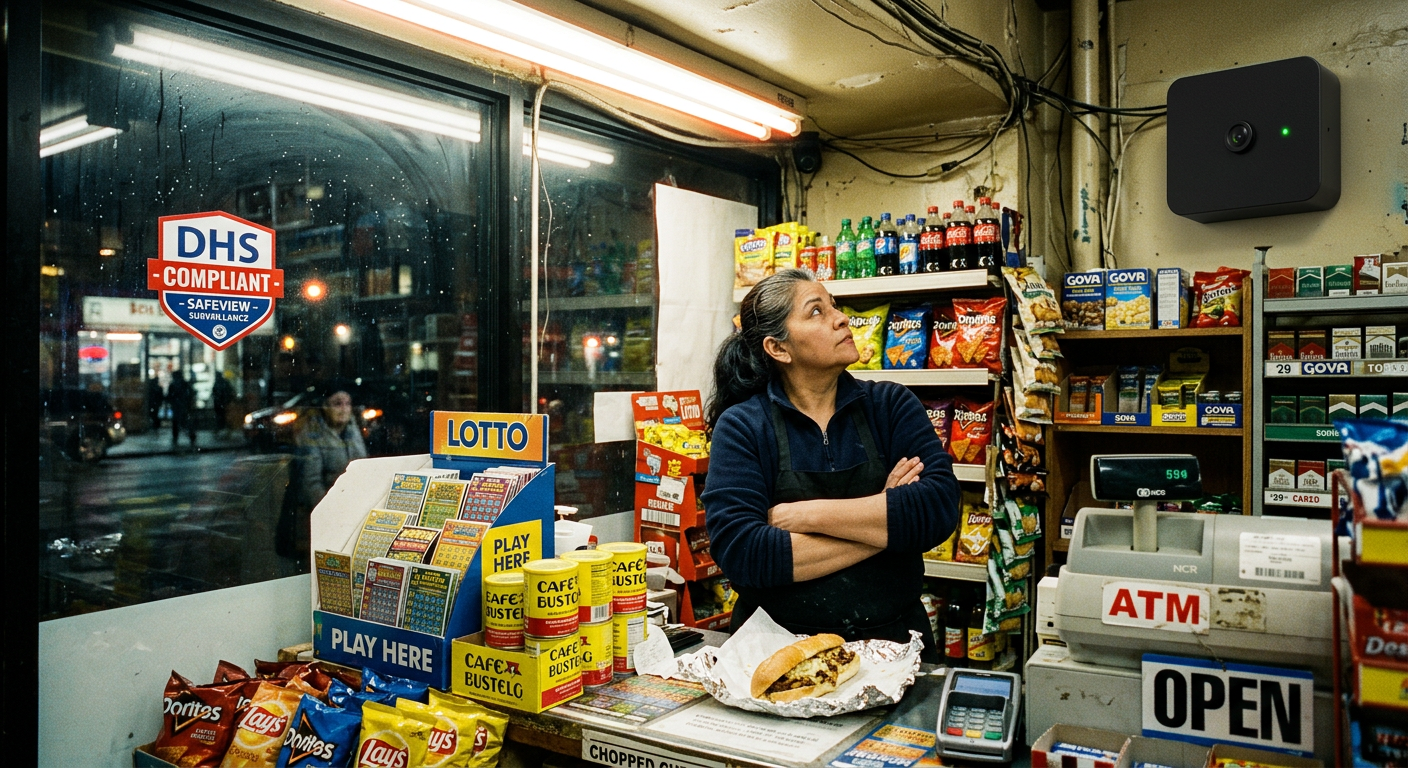
The first stop is a bodega on Willis Avenue in the South Bronx. The owner is Yolanda Matos, fifty-three, born in San Juan, running this particular bodega since 2014. She sells loosies and lottery tickets and Café Bustelo and plantain chips and the kind of bodega sandwich — chopped cheese on a hero, bacon egg and cheese on a roll — that sustains a neighborhood where the median household income is $24,000 and the nearest supermarket is a forty-minute bus ride.
Yolanda has four cameras already. Three are Sentinel Eye units — the government-mandated system, installed by a DHS-contracted firm called SafeView Solutions, which charges $89 per month per camera for “compliance monitoring services.” The fourth camera is a twenty-year-old Lorex analog unit that Yolanda bought at a flea market in 2011 and refuses to take down because it’s the only one she actually controls.
“The SafeView cameras,” Yolanda says, standing behind the counter with her arms crossed, watching Dixon unpack the OHC unit. “You know what they do? They watch me. Not the store. Me. My register. My inventory. The DHS man comes every month, looks at his tablet, tells me my ‘compliance score.’ Last month I scored 714. He said I need to be above 750 or they increase inspections. I asked him what I did wrong. He said my inventory tracking shows ‘anomalous purchase patterns.’ I buy rice and beans in bulk from a cousin in Bayamón. That’s the anomaly. That’s the crime.”
Dixon sets the OHC camera on the counter. It’s matte black, featureless except for the lens and a small green LED.
“This runs two firmware stacks,” he says. “The surface layer looks like a Sentinel Eye unit. Passes the compliance scan. Reports to the DHS registry. Shows them whatever they want to see.”
“And underneath?”
“Underneath, it records to local encrypted storage. Full 4K. The footage stays on the device until you authorize a burst to the mesh. Nobody sees it but you — unless you opt into the data commons.”
“What’s the data commons?”
This is the part that takes longer to explain than the technology. Because the technology is simple — dual firmware, encrypted storage, mesh relay. Store owners understand dual firmware intuitively. They’ve been hiding things from inspectors since inspectors existed. The Sentinel Eye cameras are just the latest version of the health inspector who checks the kitchen but never eats the food.
The data commons is different. The data commons is the idea that the footage from Yolanda’s cameras — anonymized, timestamped, geolocated — has value beyond security. Not surveillance value. Not advertising value. Provenance value.
“Say your cousin in Bayamón ships you fifty pounds of rice,” Dixon says. “Under ASHPA, that’s a flagged transaction — cross-border supply chain, unregistered vendor, anomalous inventory pattern. The DHS algorithm flags it. Your compliance score drops.”
“That’s what happened.”
“Now say your cousin packs the rice under a Witness camera. The camera records the packing process — the rice, the bags, the shipping label, the timestamp. The footage goes to the data commons. When DHS flags your inventory, you can point to the provenance chain: this rice was packed by this person, at this time, in this location. Human hands. Known supply chain. Verified.”
“And DHS accepts that?”
Dixon pauses. This is the honest part. "No. DHS doesn’t accept anything from the data commons. DHS doesn’t acknowledge the data commons exists. But the Andean Bloc does. The EU does. Fourteen countries accept OHC provenance chains as trade documentation. And when ASHPA collapses — "
“If.”
“When. When it collapses, the businesses that have provenance chains will have documentation. The ones that don’t will have nothing. I’m not selling you a camera, Yolanda. I’m selling you a receipt book that the next government will actually read.”
Yolanda looks at the camera. She looks at the three SafeView units on her ceiling — the ones that watch her register, her inventory, her face — and at the old Lorex unit that she trusts because she owns it.
“How much?”
“Free. The camera is free. The mesh relay is free. If you opt into the data commons, you get a dividend — Equi, deposited monthly, based on the volume and quality of the footage.”
“How much dividend?”
"Depends on the network. Right now, about forty Equi per month per camera. That’s — " he does the conversion, which changes daily — “about sixty-two dollars.”
Yolanda’s rent on the bodega is $4,800 per month. The SafeView cameras cost her $267 per month total. Sixty-two dollars from the OHC dividend wouldn’t cover the SafeView bill. But it would cover the loosies markup, or the rice shipment from Bayamón, or the gap between what food stamps cover and what her regular customers actually need.
“Put it up,” she says.
Dixon installs the camera in seven minutes. He’s done this forty-six times in the past two weeks — bodegas in the Bronx, tiendas in Washington Heights, a halal grocery in Jackson Heights, a Jamaican bakery in Flatbush. The physical installation is identical each time: mount bracket, run power from the nearest outlet (the cameras draw 3.2 watts, less than an LED bulb), pair with the mesh network, run the firmware initialization.
The firmware initialization is the careful part. Copernicus handles it remotely, but Dixon watches the sequence on his phone:
-
Boot into Sentinel Eye emulation. The camera identifies itself to the DHS registry as a SafeView Model SC-4000, serial number generated from a pool of decommissioned units. The registry accepts it. As far as DHS knows, Yolanda upgraded her existing SafeView hardware.
-
Establish compliance heartbeat. Every fifteen minutes, the camera sends a status packet to the SafeView cloud — a synthetic telemetry stream that Copernicus generates from a model trained on actual SafeView traffic patterns. Frame rate, exposure, motion events, connection quality. All fabricated. All statistically indistinguishable from a real SC-4000.
-
Initialize substrate layer. Beneath the Sentinel Eye emulation, the OHC firmware activates. Encrypted storage. Mesh relay pairing. Data commons handshake. The two firmware stacks share the same sensor hardware but maintain completely separate data paths. The Sentinel Eye layer sees what DHS expects to see. The substrate layer sees what’s actually there.
-
Generate camera identity. Each Witness camera gets a cryptographic identity — a key pair anchored to the OHC trust chain. The private key never leaves the device. The public key registers with the data commons. This identity is the foundation of the provenance system: footage from this camera, signed with this key, can be verified by anyone with access to the commons.
The green LED blinks twice. The camera is live on both stacks.
“You won’t see any difference,” Dixon tells Yolanda. “The SafeView app on your phone still works. The compliance scan still passes. The DHS inspector sees what he always sees.”
“And the other footage?”
“Encrypted on the device. Bursts to the mesh between 2 and 5 AM, when network traffic is lowest. If you want to review it, there’s an OHC app — but don’t install it on your main phone. Use the burner I’m leaving you.”
He hands her a Nokia feature phone — an OHC-modified unit with a stripped-down mesh client. No GPS. No app store. No DHS telemetry. Just a simple interface for reviewing footage, authorizing data commons uploads, and checking the Equi dividend balance.
“One more thing,” Dixon says, shouldering the duffel bag with the remaining cameras. "If a compliance inspector asks about the camera — "
“It’s a SafeView SC-4000. I bought the upgrade online. I have the receipt.” She smiles. “I’ve been hiding things from inspectors longer than you’ve been alive, baby.”
By the end of March 2030, Dixon has installed 214 Witness cameras across four boroughs. The mesh network forms a constellation across the city — each camera relaying to its neighbors, the data flowing through the mesh like water through capillaries, converging on relay nodes hidden in laundromats and barbershops and the back rooms of restaurants where the owner knows what the green LED means.
The footage accumulates. Bodegas. Bakeries. Auto repair shops. Laundromats. Nail salons. The quotidian infrastructure of neighborhoods that the formal economy forgot. Yolanda’s rice shipments from Bayamón. A mechanic in Hunts Point rebuilding a transmission under two Witness cameras — forty hours of process footage that proves every part was sourced, every bolt torqued, every step human-performed. A seamstress in Sunset Park altering quinceañera dresses under a Witness lens, building a provenance chain for handmade garments that the data commons values higher than factory output.
None of this matters to DHS. DHS sees 214 SafeView cameras reporting nominal compliance telemetry from the Bronx, Manhattan, Brooklyn, and Queens. The compliance scores hold. The monthly inspectors come and go. The bodega owners smile and the inspectors check their tablets and nobody looks up at the camera that’s watching them both.
It matters to Dixon because every camera is a vote. Not a political vote — an economic vote. A declaration that this person, in this place, did this work, and the data commons recorded it. Two hundred and fourteen stores. Two hundred and fourteen witnesses. A network of eyes that belongs to the people behind the counter, not the people behind the badge.
Copernicus runs the numbers every night. Camera uptime: 97.3%. Mesh relay integrity: 99.1%. Data commons ingestion rate: 4.2 terabytes per month. Provenance chains generated: 1,847.
In Cochabamba, Tunupa receives the provenance data and begins training the validation models. The AI that watches the footage doesn’t store the footage — it generates process signatures, compressed representations of human activity that can verify authenticity without exposing content. A zero-knowledge witness. An eye that sees everything and tells nothing except the truth.
Dixon doesn’t know yet what the network will become. He doesn’t know about the provenance wars or the forgery attacks or the day when a camera in a Medellín tienda will record the creation of a painting that changes the legal definition of authorship in fourteen countries. He doesn’t know that the green LED blinking in Yolanda’s bodega is the first heartbeat of a system that will, by 2035, make the case for human-AI creative partnership to the United Nations.
He knows that Yolanda’s compliance score went up four points this month, and that the rice from Bayamón arrived without a flag, and that the Equi dividend covered the loosie markup.
He shoulders the duffel bag and walks to the next bodega. Eleven more cameras today. The network grows.