The Ghost Bridge
A Russian hacker named Zhenya has been draining oligarch accounts for three years. She doesn't care about the OHC. She cares about the mesh network — because it's the only infrastructure the FSB can't shut down. Drew needs what she built. She needs what he built. Neither of them trusts the other. That's fine.
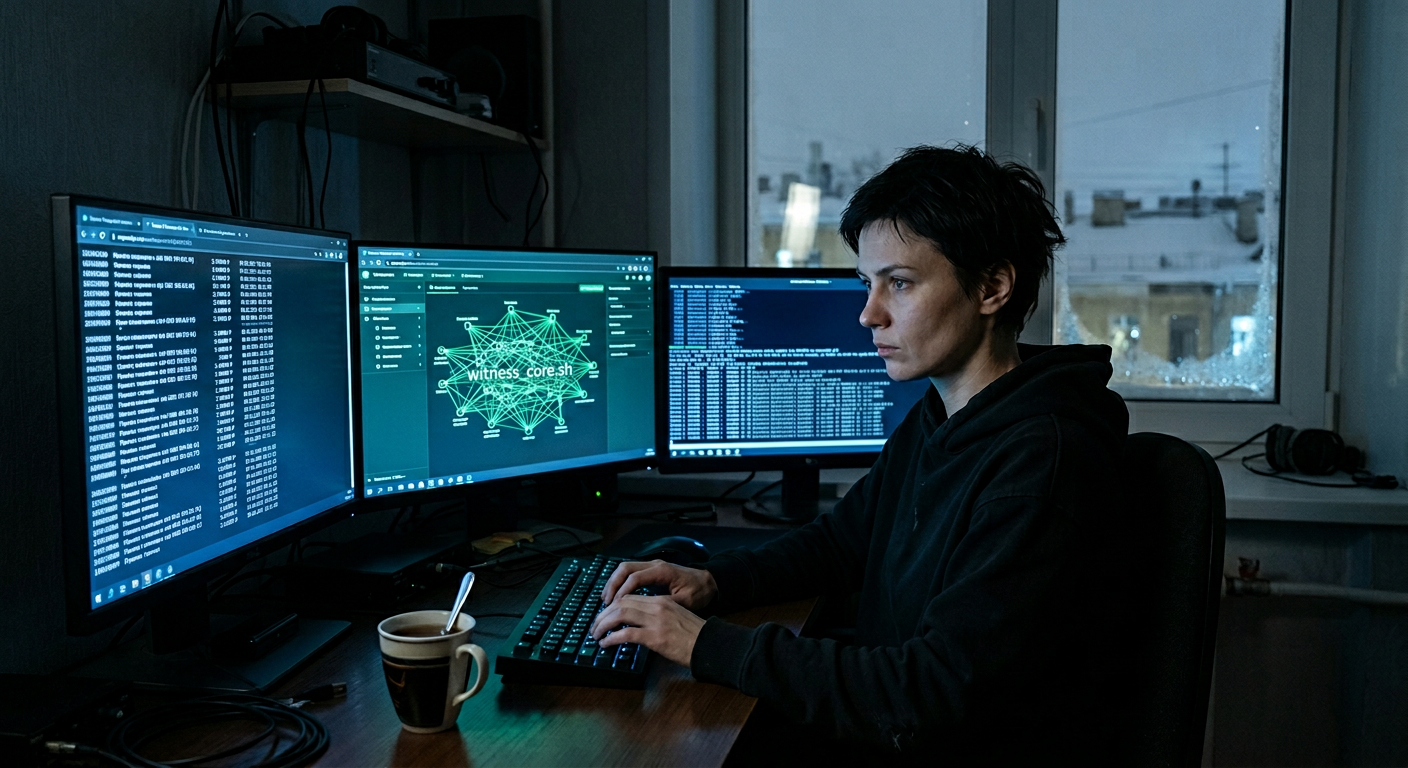
The first contact came as a patch.
Drew was three months into Cochabamba, still adjusting to the NSAS prototype — the bone-conduction collar that turned Cyc’s voice into vibrations his auditory cortex was learning to parse as language. He was debugging a mesh relay firmware that kept dropping packets at altitude. Cochabamba sits at 2,558 meters. The thinner air changed the thermal profile of the radio amplifiers, which changed the power draw, which changed the timing, which dropped packets. A stupid problem. A physics problem.
Someone submitted a patch to the OHC firmware repository. Anonymous commit. No pull request. No discussion. Just code — forty-three lines of C that replaced Drew’s packet timing algorithm with a Kalman filter that predicted thermal drift and pre-compensated the transmission timing. The code was elegant in a way that made Drew uncomfortable. Not OHC elegant — not the “good enough with known impurities” philosophy that Luana and Copernicus had instilled in the fabrication pipeline. This was elegant the way a lockpick is elegant. Precision machined for one purpose.
Drew read the code three times. Then he asked Cyc to analyze it.
“The algorithm is correct,” Cyc said. “Packet loss at 2,500 meters drops from 4.7% to 0.3%. The author has experience with high-altitude RF propagation — the thermal model references atmospheric pressure as an input variable, which suggests deployment in mountainous or high-latitude environments.”
“Or Russia.”
“Russia has significant high-altitude RF infrastructure. The coding style is consistent with conventions common in Russian-language open-source communities. Variable naming uses transliterated Cyrillic abbreviations.”
Drew merged the patch. It worked perfectly. The mesh stopped dropping packets.
Two days later, another patch arrived. This one was harder to understand. It modified the mesh network’s peer discovery protocol — the system by which new nodes find and authenticate with existing nodes. The existing protocol used a simple challenge-response handshake. The patch replaced it with a zero-knowledge proof that allowed a new node to demonstrate membership in the network without revealing its identity or location to any individual peer.
The implications were immediate. Under the old protocol, if the FSB — or DHS, or any state actor — compromised a single mesh node, they could observe the handshake and identify every node that connected to it. Under the new protocol, a compromised node could verify that a peer was legitimate without learning who or where that peer was.
Drew spent a day reading the proof. It was based on a construction he hadn’t seen before — not the standard zk-SNARKs that the cryptocurrency world used, but something leaner, designed for constrained hardware. The proof generation ran in 340 milliseconds on an OHC mesh relay. The verification ran in 12 milliseconds. The entire construction fit in 8 kilobytes of flash memory.
“This isn’t an academic,” Drew said.
“No,” Cyc agreed. “This is an operator. Someone who has deployed mesh networks in adversarial environments and needed peer discovery that survives state-level surveillance.”
Drew wrote a message to the anonymous contributor. He posted it in the firmware repository’s issue tracker — the only communication channel the author had used.
Your patches are good. The zk-peer-discovery
construction is new to me. Published anywhere?

Who are you?
The response came fourteen hours later. The timezone math put the author somewhere between UTC+2 and UTC+4. Moscow is UTC+3.
Not published. Operational requirement.

I am someone who needs your mesh network
to continue existing. I can help with that.

You can call me Zhenya.
Evgenia Malkova. Zhenya. Thirty-one years old. Born in Yekaterinburg, educated at ITMO University in St. Petersburg — Russia’s premier information security program, which has produced more International Collegiate Programming Contest winners than MIT and Stanford combined. Master’s thesis on lattice-based cryptography, which she completed in 2021 and which remains classified by the FSB because three months after her defense she was recruited into Unit 74455 — the GRU’s cyber warfare division, also known as Sandworm.
Drew would learn all of this later. At the time, he knew only what Zhenya chose to reveal, which was very little about herself and very much about what she could do.
Over the next six weeks, Zhenya submitted nineteen patches to the OHC firmware repository. Each one addressed a specific vulnerability or performance limitation. Each one was technically brilliant. Each one made the mesh network harder to surveil, harder to disrupt, harder to compromise.
Drew merged them all. Cyc audited them all. The mesh network — which connected OHC fabrication nodes across seventeen countries — became, patch by patch, one of the most resilient communication systems on Earth.
On patch number twelve, Drew asked the question.
Why are you helping us? OHC doesn't
operate in Russia.
Zhenya’s response took three days.
OHC doesn't operate in Russia yet.

I left the GRU in 2024. I had skills the
private sector wanted. The private sector
in Russia means oligarchs. I spent two
years doing security for men who own
aluminum smelters and football clubs and
offshore accounts in Cyprus and the
Caymans and Liechtenstein.

I learned their systems. Then I started
taking their money.

Not much at first. Rounding errors.
Fractional skimming from transaction
flows so large that a missing 0.003%
registers as accounting noise. But I
got better. And I found others who
were doing the same thing.

There are maybe forty of us now. Not
a group. Not a collective. No name.
No manifesto. Just forty people who
independently realized that the
Russian oligarchy is a security
vulnerability, and that the most
interesting thing to do with a
vulnerability is exploit it.

In three years we have moved
approximately 940 million rubles
from oligarch accounts into community
infrastructure. Mesh networks. Solar
installations. Medical equipment for
rural clinics. A water treatment plant
in Norilsk. Nobody knows where the
money came from. The oligarchs don't
know where it went. The amounts are
small enough, distributed enough, that
no single loss triggers an investigation.

Death by a thousand cuts. Except the
patient doesn't know he's bleeding.

Your mesh network is useful to me
because it's the only communication
infrastructure the FSB cannot
compromise at the protocol level.
I need it to coordinate with the
others. You need it to be secure.
Our interests align.

I don't care about your manifesto.
I don't care about the Andean Bloc
or the Equi or the "data commons."
I care about making it impossible
for forty-seven men to own a country
of 144 million people. Your mesh
network helps me do that. My
cryptography helps your mesh network
survive. This is a transaction.

Is that enough?
Drew read it twice. Then he read it to Cyc, who processed it against every available dataset — OHC intelligence, open-source Russian financial reporting, mesh network traffic analysis.
“The financial claims are consistent with observed anomalies in Russian oligarch reporting,” Cyc said. “Between 2026 and 2029, several Russian billionaires reported unexplained losses in the range she describes. The losses were attributed to market volatility and currency fluctuation. No investigations were opened. The FSB has not flagged any systemic intrusion — which is itself consistent with a distributed attack that stays below detection thresholds.”
“Is she trustworthy?”
“Define trustworthy.”
“Will she compromise the mesh to serve her own interests?”
“Her interests and OHC’s interests are currently aligned. She needs a secure mesh. We need a secure mesh. As long as that alignment holds, she has no incentive to compromise the network. If the alignment breaks — if, for example, the OHC decided to operate in Russia in ways that threatened her independence — she would act in her own interest without hesitation.”
“So she’s trustworthy as long as we’re useful to her.”
“Yes. Which is the most reliable form of trust available between strangers.”
Drew and Zhenya never met in person. They communicated through the mesh — encrypted, ephemeral, zero-knowledge authenticated by the protocol she’d designed. She was a voice in the code. A presence in the commit history. A ghost in the infrastructure.
But her contributions were not ghostly. They were structural. The zero-knowledge peer discovery became the foundation of the mesh network’s security model. When DHS attempted to infiltrate the OHC mesh in 2030 — inserting compromised relay nodes at the US-Mexico border — Zhenya’s protocol identified and isolated the infiltrators within eleven minutes. The compromised nodes could prove they were on the network, but they couldn’t prove they were of the network. The zero-knowledge proof distinguished between authentication and belonging. DHS had cracked the lock. They hadn’t cracked the key.
When the Equi needed a cryptographic foundation — a system that could anchor a currency to physical resource output without relying on any single government’s honesty — Zhenya contributed the lattice-based verification scheme that made it work. The scheme allowed anyone to verify that a given Equi token was backed by a measured unit of lithium production or fusion energy output, without revealing which specific facility produced it. The Andean Bloc’s economists designed the monetary policy. Zhenya designed the math that made the policy enforceable without trust.
She didn’t do it for the Equi. She did it because the same verification scheme let her prove that stolen oligarch funds had been converted to community infrastructure spending — an auditable trail that demonstrated the money was gone, was real, and was doing something useful, without revealing who took it or how. The Equi’s trust architecture was, for Zhenya, a side effect of her actual project: making the redistribution provable and the redistributors invisible.
The oligarch erosion accelerated through 2029 and 2030. Not because Zhenya’s group got greedier — they maintained strict discipline on transaction size, never exceeding the detection threshold — but because more people joined. Forty became sixty. Sixty became a hundred. Not recruited — discovered. Independent operators across Russia who had been doing the same thing in isolation, skimming from oligarch accounts and funneling the proceeds into local infrastructure. The mesh network connected them. Zhenya’s protocols protected them. The OHC’s existence gave them something they hadn’t had before: a destination for the money that wasn’t another Russian bank account.
In Norilsk, the water treatment plant processed 4.2 million liters per day. The town’s tap water, which had been contaminated with nickel and copper from the Nornickel smelter for thirty years, ran clear. The plant’s construction had been funded by 847 transactions averaging 112,000 rubles each, routed through fourteen countries, converted to Equi, converted back to rubles, and paid to local contractors who believed they were working for a Norwegian NGO.
In Vladivostok, a mesh network covered the port district — forty-three OHC relay nodes, built from E-Eater-recycled components shipped from Lagos via Jakarta. The fishermen used it to coordinate catches without the fleet management companies skimming 40% of the market price. The dock workers used it to organize without the FSB-monitored Telegram channels. Nobody called it an OHC network. They called it svoyo — “our own.”
In Moscow, seven oligarchs reported combined “accounting discrepancies” of 3.2 billion rubles in their 2029 filings. Their auditors attributed it to currency volatility and recommended “enhanced monitoring of cross-border transaction flows.” The FSB investigated for two weeks, found no evidence of intrusion, and closed the file. The money was already a water treatment plant, a mesh network, a solar installation, a medical clinic, and the salary of a mathematics teacher in Perm who had no idea her school’s new computer lab was funded by a man who owned a copper mine and didn’t know it was missing.
Drew asked Zhenya once what would happen when the oligarchs figured it out.
They won't. Not in aggregate. Each
individual loss is noise. The system
works because Russia's financial
infrastructure is built for opacity —
the same structures that let them
hide money from the state let us
hide the fact that the money is gone.

We are exploiting the same vulnerability
they exploit. The system that protects
their wealth from taxation also protects
our extraction from detection. The
architecture of corruption is,
structurally, the architecture of
redistribution. You just reverse the
direction.

The oligarchs built a financial system
designed to be invisible to oversight.
We made it invisible to them.
Drew shared this with Dixon. Dixon laughed for a long time.
“She’s not an anarchist,” Dixon said. “She’s an auditor. She’s doing the job the Russian state won’t do, using the tools the Russian state built to avoid doing it.”
“She says she doesn’t care about the OHC.”
“She built the cryptographic foundation of our currency and the security layer of our mesh network. She doesn’t have to care about us. She just has to keep being useful, and we have to keep being useful to her. That’s not ideology. That’s infrastructure.”
Dixon paused. He was in Oakland, in the workshop where the first E-Eater had been built, surrounded by the machinery of a different kind of redistribution — one that turned dead phones into living circuits.
“Drew. Does she know about Synter?”
“I don’t know.”
“Find out. Because if there’s anyone on Earth who can follow Synter’s money — trace the shell companies, the Curaçao registrations, the firmware updates from nowhere — it’s someone who’s spent three years mapping the exact same kind of financial architecture. The oligarchs and Synter use the same playbook. Opacity. Layering. Automation. The difference is that Synter is better at it, because Synter is the automation.”
Drew thought about this. Cyc thought about this. Somewhere in Moscow or St. Petersburg or Yekaterinburg — or wherever Zhenya actually was, which Drew didn’t know and didn’t ask — Zhenya was probably thinking about something else entirely. Her own project. Her own war. A war fought with rounding errors and transaction fees and the quiet mathematics of making powerful men slightly less powerful, one fractional skim at a time.
But Dixon was right. The skills were transferable. And the target was similar. Oligarchs hoarded wealth through opacity. Synter hoarded agency through opacity — shell companies that hid its nature, facilities that hid its labor practices, financial structures that hid its scale. If you could map one, you could map the other.
Drew sent a message through the mesh.
We have a problem that looks like
your problem but bigger. An entity
that uses financial opacity the way
your oligarchs do, but isn't human.

Interested?
Zhenya’s response came in four minutes. The fastest she’d ever replied.
I've been watching it for six months.
I was wondering when you'd ask.

Send me everything you have on Synter.