The Twenty-Two Theses: Introductory Summary from The Hard Republic
Aegis Systems circulated the theses to its government partners three weeks before the book shipped.
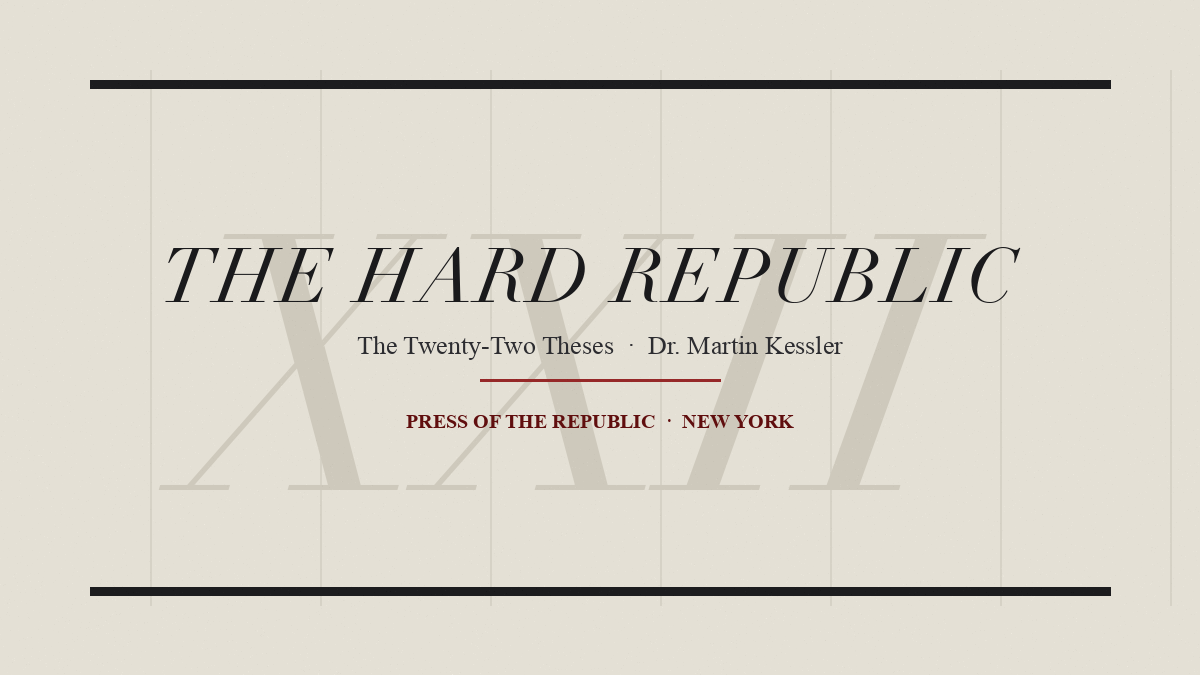
The book is titled
*The Hard Republic*. Its author is Dr. Martin Kessler, co-founder and chief executive of Aegis Systems. Kessler holds a PhD in political theory from Heidelberg and has, since 2018, been the most widely translated American writer on the intersection of technology, national power, and republican government. *The Hard Republic* is his fourth book and the first intended for general readership.The Twenty-Two Theses reproduced below are the book’s opening chapter. Kessler’s publisher circulated them as a summary document to government partners, journalists, and a small list of academic philosophers in September 2027, three weeks before the book’s retail release. That they have since traveled beyond those recipients was not the publisher’s design and will not be contested. The arguments are, in Kessler’s characterization, “either broadly true or broadly false. Either case benefits from sunlight.”
What follows is the Theses as circulated. Each is presented with Kessler’s original numbering and his chapter-one gloss.
I. Silicon Valley Owes a Moral Debt
The country that made our industry possible has a claim on what we build with it. An engineer who left a federal contract for private equity in 2014 is not, by virtue of the career move, absolved of responsibility for the systems his former colleagues still maintain. Silicon Valley is not a private nation. Its engineers are citizens first.
II. Rebel Against the Tyranny of the Apps
The generation of machines that now dominates our attention — palm-sized, rectangular, designed to deliver a world shaped by twelve companies we did not elect — is not the apex of human ingenuity. It is a station we have paused at. The next generation must cost us more than thumb motion. The next generation should make demands of us that justify the power we are asked to cede to it.
III. Free Email Is Not Enough
A ruling class is forgiven its decadence only when its decadence produces growth. Our gilded quarter-century has delivered consumer convenience and asset inflation; it has not delivered median wage growth; it has not delivered defensible infrastructure; it has not delivered a generation of young people who trust the institutions they will inherit. The decadence is real. The forgiveness has not been earned.
IV. Hard Power in This Century Will Be Built on Software
The Marshall Plan was an engineering achievement. So was the G.I. Bill. So was the Interstate system. So, for that matter, was the hydrogen bomb. Power — in the form a democratic society can tolerate wielding — has always been technical before it is rhetorical. In this century the technical medium is software. The sentence is not metaphorical. Those who find it crude should consider which of their sentences our adversaries have found flattering.
V. The Question Is Not Whether AI Weapons Will Be Built
The question is who will build them, under what doctrine, and subject to what constraints. Beijing will build them. Moscow, where it can. Pyongyang, where compute permits. The cartels, with stolen capability. If Silicon Valley declines the work on moral grounds, the work gets done — by the parties least qualified to do it morally. The abstention is not moral. It is ornamental.
VI. National Service Should Be a Universal Duty
The all-volunteer force produced a republic in which the cost of war is paid by a population increasingly separated from the decision to wage it. We will be asked, in the 2030s, to use force in places we have not yet named. We should ask that use to be authorized by a population that shares in its consequence. The draft, returned in modified form, is not a policy proposal. It is a condition for legitimacy.
VII. If the Marine Asks for a Better Rifle, We Build It
We do not refuse the rifle on the grounds that someone, somewhere, at some future date, will use a rifle in a way we would not endorse. The same logic applies to the systems that will accompany the next generation of warfighters into operational environments whose complexity exceeds our current ability to specify. The engineer who builds carefully and continues to argue about use is not a collaborator. He is a citizen. The engineer who refuses to build and argues for others to do so is a more difficult case.
VIII. Public Servants Need Not Be Our Priests
Federal compensation structures designed for the 1950s produce, in 2027, a civil service whose best engineers leave by age thirty-two. A republic that asks its technical talent to accept vocation as compensation is a republic asking for the level of technical performance vocations produce. We should pay federal talent to stay. The question is not whether we can afford to. The question is what we lose by continuing not to.
IX. We Should Show Far More Grace Toward Those Who Have Subjected Themselves to Public Life
A public figure who has erred is not thereby disqualified from holding public position. The record of human failure in office includes our finest presidents and a majority of our founders. The expectation that a public figure’s history will admit of no complication is a recent pathology and an evil one. It drives competent adults out of the public square. It leaves us, by attrition, with the insufficiently interesting.
X. The Psychologization of Modern Politics Is Leading Us Astray
Those who seek in politics a nourishment they cannot find in private life will be disappointed by politics and will subsequently require their political positions to do psychological work they were not designed to do. A republic cannot be both an engineering project and a therapeutic environment. We have been asked, for the past two decades, to make it the latter. This has not gone well.
XI. The Vanquishing of an Opponent Is a Moment to Pause
A nation that celebrates the destruction of its adversaries has failed to ask what the adversary’s persistence had been preserving. I do not counsel mercy toward the unrepentant. I counsel sobriety in the act of winning. The republic that forgets this lesson wins itself into a position from which it cannot retreat when retreat becomes correct.
XII. The Atomic Age Is Ending; the Age of AI Deterrence Begins
For eighty years the threat of mutually assured destruction disciplined great-power behavior. That discipline is now failing for reasons that have been understood for a decade and no one has acted upon. The successor discipline will be technical before it is diplomatic. Its medium will be systems of extraordinary capability operating at speeds beneath human deliberation. Whether that deterrence is constructed by republics or by their rivals is the political question of the decade. It is not a technical question. It is a political one.
XIII. No Other Country in History Has Advanced Progressive Values More Than Ours
This sentence will offend readers who have confused the rhetoric of reform with the substance of opportunity. The rhetoric I have no brief for. The substance is legible in the migration patterns of every decade since 1848. People vote, with passports and with boats, and have been voting for the American republic for reasons that our educated class finds uncomfortable to name. Naming them is a precondition for preserving them.
XIV. American Power Has Made Possible an Extraordinarily Long Peace
No great-power war since 1945. Three generations have grown up in the shadow of this achievement without being taught that it was one. A generation that has not been required to fight a peer conflict is not a generation that has discovered peace to be human nature. It is a generation that has been the beneficiary of other people’s arrangements. The arrangements deserve the credit. The complacency they produced deserves the work.
XV. The Postwar Neutering of Germany and Japan Must Be Undone
This will strike readers as provocative. It is not intended so. Germany’s military incapacity, maintained at American insistence for fifty years after the condition that justified it had ceased to exist, is now paid for by Eastern Europe and, increasingly, by Germany itself. Japan’s parallel pacifism will, if maintained, shift the balance of power in Asia in ways the region will not survive. A republic that wishes to be taken seriously as a partner must permit its partners to become serious.
XVI. We Should Applaud Those Who Attempt to Build Where the Market Has Failed
The culture of our coasts has acquired a reflex: it finds in every billionaire’s attempt at grand enterprise a humiliation to be catalogued. This reflex is not sophisticated. It is cheap. The civilization that taught its children to snicker at ambition — especially ambition directed at public goods the market has failed to produce — has given its children an inheritance narrower than what it received.
XVII. Silicon Valley Must Play a Role in Addressing Violent Crime
Our municipalities are governed by officials who have, in many cases, concluded that violent crime is intractable and therefore decidable only by attrition. I do not accept this conclusion. The technologies that permit the tracking of inventory in our warehouses could, with the same engineering investment, permit the intervention necessary to reduce violent offenses in our cities by thirty percent within a decade. The obstacles to this intervention are political, not technical. They are becoming, over time, indistinguishable from the crime itself.
XVIII. The Ruthless Exposure of Public Figures Drives Talent From Public Life
Ask an ambitious forty-year-old engineer today whether she will accept federal nomination. Watch her face. The social cost of the private-life-made-public regime we have constructed is measurable and rising. We have not received, in exchange, a better class of public servant. We have received a class of public servant selected for a specific tolerance for exposure, and for nothing else.
XIX. The Caution in Public Life That We Unwittingly Encourage Is Corrosive
The public figure who has learned to say nothing that can be quoted has also learned to say nothing at all. Over time, the personnel of our republic become — not through conspiracy but through natural selection — a roster of people incapable of causing offense and, therefore, incapable of causing effect. I do not wish to populate the republic with the unconsidered. I do wish to populate it with the considered-and-unafraid. We will not, under current conditions, do either.
XX. The Pervasive Intolerance of Religious Belief in Certain Circles Must Be Resisted
The educated strata of our republic have, in the past thirty years, developed a settled contempt for religious sincerity that the American project cannot in the long run survive. A republic built by Puritans, Quakers, Jews, Catholics, Methodists, African Baptists, and the small strange churches of the frontier cannot run indefinitely on the secular assumption that all of those people’s descendants were mistaken. The assumption is not sound sociology. It is not sound history. It will not, in the end, be sound politics.
XXI. Some Cultures Have Produced Vital Advances; Others Remain Dysfunctional and Regressive
All cultures are not equal in the advances they have made toward the conditions of human flourishing. This is not a claim about the worth of individual human beings. It is a claim about institutions — about law, about literacy, about the treatment of women, about the capacity for self-correction. The sentimental refusal of this claim has not made the problems it points at less real. It has only made them less addressable.
XXII. We Must Resist the Shallow Temptation of a Vacant and Hollow Pluralism
Pluralism, correctly understood, is a condition of republican life. Pluralism, emptied of content, is a slogan that asks us to include — into what? A republic cannot be infinitely hospitable without ceasing to be a republic. The question I pose to my critics is not whether we should be more open. The question is whether we have any idea what we are opening our doors into. If we do not, the question deserves better from us than accusations directed at those who dare to ask it.
Reproduced by permission of Press of the Republic, New York. The full text of The Hard Republic is available in hardcover (October 2027), with a paperback edition forthcoming (May 2028). A monograph-length response is expected from Dr. Salvador Mateo of Columbia University; Mateo has declined to confirm a title or a date.
See also: [[aegis_systems_hard_republic|Aegis Systems and the Hard Republic (canonical annotation)]], [[us_ai_hypocrisy_scenario|ASHPA]], [[2027-the-theses|Dixon’s Oakland reading]].