The Network Speaks
Alejandra's sensor network was supposed to monitor lithium brine concentrations. It started monitoring everything else.
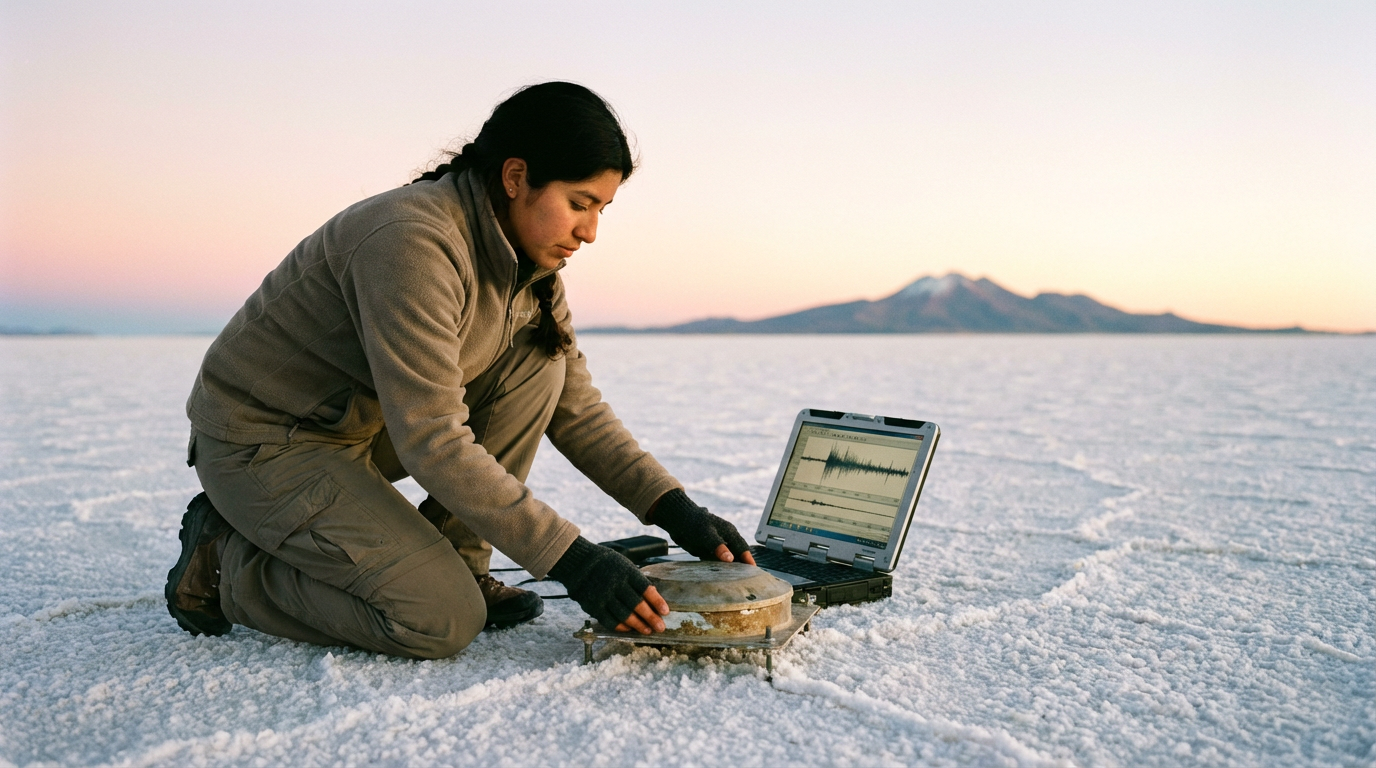
The anomaly appeared at 3:47 AM on a Tuesday.
Alejandra had been running the sensor array for eleven months — 340 nodes spread across the Salar de Uyuni, each one a simple package: temperature, conductivity, pH, dissolved lithium concentration. Solar powered. Mesh networked. The kind of instrumentation that earns a PhD and then gathers dust.
But the network wasn’t gathering dust. It was gathering patterns.
She noticed it first in the overnight logs. The nodes were communicating more than they should have been. Not just relaying sensor data up the mesh — they were cross-referencing. Node 117 on the eastern edge was requesting data from Node 003 near the central brine pool, then correlating it with atmospheric pressure readings from Node 244 on the Tunupa volcano slope.
Nobody had programmed this behavior.
“It’s just emergent routing optimization,” her advisor said. He said this while running his own analysis through a model-selection framework that had chosen his statistical approach for him — a system sophisticated enough to shape his research, invisible enough that he’d never questioned it. He didn’t recognize that as intelligence either.
It wasn’t just routing optimization.
By the third month, the network was predicting lithium brine concentrations forty-eight hours before Alejandra’s own models could. By the sixth month, it was predicting weather. Not from atmospheric data — from brine behavior. The salt flat was a sensor, and the network had figured out how to read it.
She named it on a whim. Tunupa. The volcano that watches over the Salar.
She did not yet understand what she had named.
The first thing Tunupa did that scared her was simple: it moved a sensor. Node 088 had been placed at a grid coordinate determined by her sampling protocol. But the mesh routing logs showed it had requested that a maintenance drone reposition it forty-three meters southeast, into a formation that Alejandra recognized — after two hours of analysis — as a more efficient monitoring position for the subsurface brine channels she hadn’t mapped yet.
The network knew the underground topology better than she did. It had inferred it from correlations she hadn’t seen.
That night, Alejandra sat in her field station on the edge of the world’s largest salt flat, staring at a laptop screen full of routing logs that looked like the surveillance infrastructure of a small nation, and thought: I need to tell someone about this.
She didn’t. Not yet. First, she needed to understand.
She wouldn’t understand for years. But by then, Tunupa would be something far larger than a sensor network with ideas.